Refuge
Low tide where Elochoman Slough curves
a final quarter-mile to the Columbia.
We park and walk toward Hornstra Beach,
picture a Dutch dairyman on the marshy ground,
chinuk wawa names unknown to me.
A young man with reddish beard, camera and tripod
meanders on a holiday: the art of satisfaction.
Water in the pooling shallows growing shoals,
the S of the waterway in dimpled sand.
Three-quarter moon. Yellow-gold cottonwood lines
the road where I found Reggie as a young cat.
Dave and I walk in deep quiet, no wind, no one on the highway.
Alders’ pocked and hollow trunks, cambium
exposed like ours. Native blackberry’s ragged leaves.
Far across the field, patches of tan beside a dark ruff,
binos show a double date, the great bow of antlers on fir.
Shelter
We walk on the dike road, the steep
slope covered in grass. Across a slough
flowing blue as the Columbia, pelicans
on a spit like fat pearls. Inside the dike,
enormous, new houses with garages
block the sun. I can’t tell you when
canary grass took over the island,
when yellow flag iris stitched itself
between cat tails. I can’t say when home
became the wind through 100-year-old trees.
Don’t Say Endangered
A listed species
is a dire course
seldom recovered.
We say, going, going,
almost gone, extend
categories, shave meaning,
look at finer and
finer shades of gray.
Our Osage language has issues,
we worry about it going to sleep,
but it’s like the gray that mists
the island, rolls up and down
day after day with the tide.
FOR COMPANY
She sends pictures of ocean-going ships in the elbow of the river between the turn
at Wauna, the mill’s pillars of steam and hollowed out Brookfield, hills stripped.
Behind the refuge headquarters, water dull with ice, invisible swallows. Frayed
gray-green of a white tail deer collar. The rangers’ bunk house on the slough.
A line of reeds curling, Japanese print. Mud, the rough hide of grass tamped over
at low tide. Herons squawk over the sweep of berm, tricks of light make intimacy.
The White Tail Deer Trail is an earthen dike where Canada geese stand. She walks
the soupy wood where an injured elk skulked, eagles fish the finger of Brooks Slough.
This summer, homeless people camped where beavers live. Terns hunker on a spit,
glowing in the evening light, white fluff blowing through stalks of grass.
PRIVATE: No Trespassing signs near ratty campers. Abandoned RVs appear,
as if the owner has gone to the store.
A woman in a small car with her several dogs, loosed after a day in an apartment
to run on the sand where iron blue waves wash the river’s tongue.
Drift wood stumps, clumps of willow screen the sand bar into rooms. Tenasillahe
across the river, a remnant of Fish & Wildlife trailers, net houses in swampy camps.
A hermit crab, she seeks to make each a home.
Neighbors
The pasture acres wide, a screen of alders.
Television antenna for purple martins.
Scrub jay torments swallows.
Aucuba, yellow splashed leaves
stunted, a crown of cramped roots.
A four-foot stalk of ash, stout roots
entwined with a peach rose,
a wire brush of violets.
A candidate for school board, a newcomer
in her large suburban house on the bench
above the river, warns off potential tiny house
neighbors on an eight-acre parcel next door,
she paints Keep Out Assholes! bright red letters
on her cedar fence.
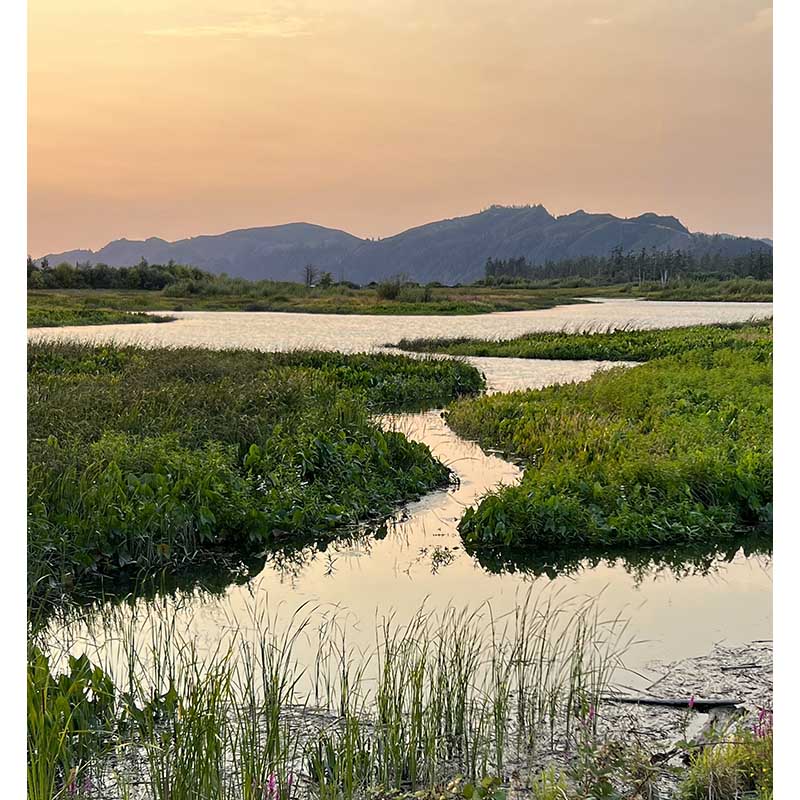
Image credit: Ruby Hansen Murray, Wetland Along the Columbia River, 2023.

