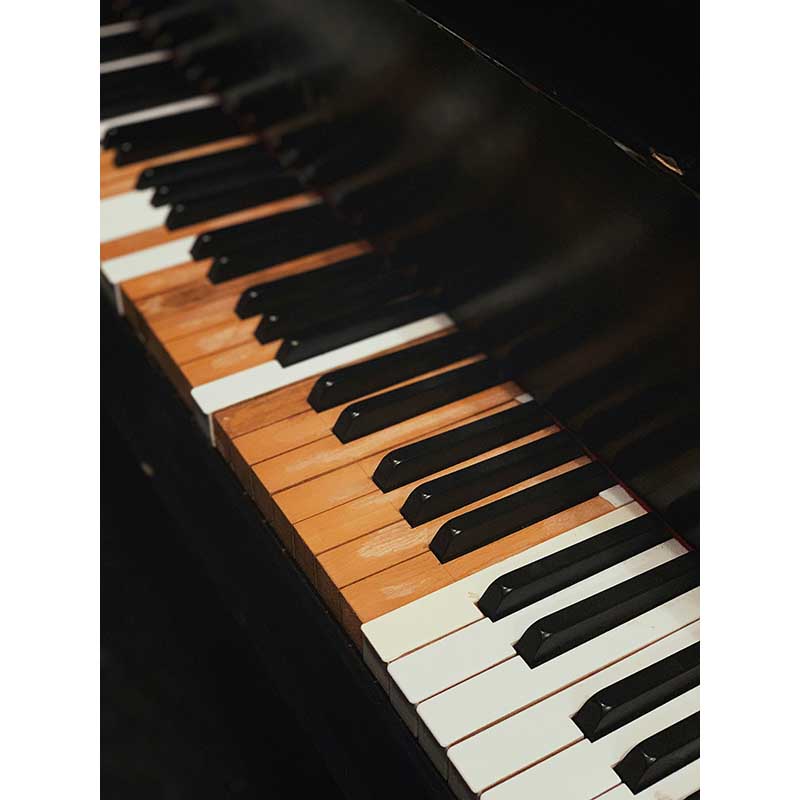
They knew Ana, of course, who was already famous the night she marched out onto the stage in Figaro “Fig” Meersham’s wake, the score of Particle Music pressed to her wan bosom, and sat down in the chair beside the piano bench. They just didn’t expect to see her that night. At least, not onstage. The murmurs continued long after the initial applause had died down, until a few audience members shushed, and Fig threw the auditorium a telltale glare.
She was famous, this Ana, though they’d never heard her play a single note: the waif who had been spirited away from her Siberian village at the age of six by the music-besotted minor oligarch Boris Tradensky after he heard her extemporize on a Bach fugue. In Moscow, she had endured a near-decade of abuse and neglect at the hands of the state conservatory’s drunken headmaster, Igor Pugnasitch, the “master of a thousand studies”; and from her fellow students, for whom she was regularly enlisted to play, as a way of humiliating them for their washerwomen’s elbows, bent wrists, errant phrasing, sloppy pedaling, scant attention to markings, and strained rubato. Excelling in nothing but cruelty, they tormented the wee prodigy with cakes of soap and wire brushes and freezing water, and whatever scant else they were able to get their hands on, in combination with their own bodily excretions. This was the house of horrors from which Fig, the enfant terrible of the piano, had rescued her, after she disappeared for two years following her gold-medal performance at the Barilla International Piano Competition in Milan at the age of thirteen. By then, the bemedaled Ana had thrice attempted to take her own life by throwing herself out of her dormitory window. But—as she would remark years later—she came from hardy peasant stock and was not so easy to kill, even by her own hand, adding, with a smirk, “After the second time they put bars on the windows.” The slight limp with which she walks today has been pointed to as the residue of these terrible plummets, just as her slight hunch has been attributed to the neuritis resulting from the years of cold she suffered while under Pugnasitch’s foul rule.
They knew about Fig’s smuggling Ana out of Russia inside a piano he purchased from an obscure Moscow fabricator, whose pianos would henceforth bear Fig’s name emblazoned above their keyboards. As the story goes, Fig had fallen in love with the waif as soon as he clapped eyes on her. Or perhaps, upon seeing her lamentable condition, his heart misgave him? Pity may have been the more foreign emotion to him, but love seems equally implausible. Not because Fig was a womanizer—and if he were, he would hardly be the first Don Juan reformed by an image of pure, angelic girlhood—but because Ana was, as almost every commentator has taken the opportunity to remark, startlingly plain: a gray, gangly serf’s daughter, battered, anemic, and underweight, knock-kneed and rickets-wracked. The small army of matrons Fig would hire to “finish” her once she arrived safely in New York claimed that she was as unfinishable as a drooling idiot-child scraped off the porch of a Georgia hog farm—which, in Russian terms, was not far from the truth. Books slipped from her head like blocks down the fabulously inclined planes of high school physics problems. Elocution in her new tongue was proclaimed a lost cause—though admittedly her thick accent had a certain charm—as were any and all attempts to stop her from picking her teeth, nose, crotch, etc., challenging Fig to see who could blow snot farther, or to get her to hold her silverware in a way that valorized the evolution of the opposable thumb. There was, her exasperated teachers said, something incorrigible about her, this wild child Fig had taken for his Pygmalion. Not strength, they said—this though Pugnasitch is rumored to have quoted Goethe’s words about Clara Weick the day Fig took her: “She has the strength of six boys together”—but something closer to a mule’s pulling against its reins; an unconscious stubbornness, a peasant willfulness and hideboundedness. Neither the sparkle of whimsy nor the fire of ideology was behind it, no motive beyond individual, self-justifying acts of resistance. Perhaps the Russian authorities, who were no doubt aware of Fig’s ridiculous “rescue mission,” were just happy to be rid of her?
It became common to see them strolling arm in arm through Central Park, or sitting together in the vicinity of the Shakespeare garden sharing ice cream, the couple forming an ambiguous tableau. Some said Fig had proposed to her immediately upon crossing into Romania, his lips pressed against the trunk concealing both his piano and soon-to-be betrothed—even that he had made her freedom contingent upon accepting his offer; she wore no ring, they said, so as to avoid a scandal. Legally, however, Ana was Fig’s daughter. Fig had given her a home, and was poised to give her his devoted mentorship. Over the three years between assuming legal guardianship and Ana’s eighteenth birthday, Fig promised to make her not only a world-class pianist—as if she were not that already—but a performer.
That Fig of all people would teach Ana how to comport herself on the concert stage was an irony not lost on the musical public. Fig was notorious for his mid-program tantrums—over some error only he heard, or some errant cough in the auditorium, etc. He literalized Chopin’s comment that what the public wanted to see was performers “banging their piano to bits.” Videos of his tantrums have garnered tens of thousands of views, including one justly-famous montage of alternating slow- and fast-motion destruction set to heavy metal music. Most of Fig’s peers regarded his disruptive volatility as a distraction from his calling as their generation’s premiere interpreter of the Romantic canon, a volatility which, as Fig crested forty without the least sign of reform or even contrition, they began to despair of him ever outgrowing. It was easy enough to blame his public: that motley assemblage of young classical music fans, adherents of other (often extreme) genres, and thrill-seekers, who were as willing to pay the extra premium on their tickets to cover the insurance costs of venue and piano as they were disappointed when the concert ended without a sliver of the piano to take home with them.
According to the entourage who rode on the laces of Fig’s designer sneakers, he would position Ana beside his piano while he practiced, the more fully to harness her talismanic power. That she calmed the savage beast was evident enough—for better or worse, since so much of the frisson of a Fig recital depended on the possibility that it would go from Liszt to apocalypse without even a semiquaver’s rest. At concerts, Ana would fidget in the front row of the orchestra, slightly right of center. Eventually, however, Fig came to prefer her to stand just off stage right, where a trick of perspective made it appear that a wallet-sized Ana was standing inside the piano. That was where he really wanted her; there, or perhaps inside a trunk that doubled as a piano bench. At the end of a performance he would open the lid, and out she would spring, like a magician’s assistant.
Concerns were raised not so much about Ana’s tainted innocence, or Fig’s corrosive effect on her character—that this child of misfortune would be spoiled by the childless, mercurial, eccentric virtuoso—as about her career. A fifteen-year-old girl reputed to outshine him at playing his own repertoire: what better way to keep her under his thumb than to give her no space, no air, no time to herself, to develop into a young woman? Three years, the music press was quick to observe, was the time Kalkbrenner had offered to tutor Chopin—an offer Chopin wisely refused. But then Chopin had been an adult, albeit a sickly and child-small one; an emigree like Ana, true, but not entirely without resources: he had consulted with his old piano teacher before making his decision. Ana was a child whose family might as well have lived on another planet, with no home but the one Fig had made for her. She had gone from one immurement to another: a penthouse apartment on Central Park West, a room with an adjoining bath and enormous windows looking out over the park’s wilder north end, the very piano in which Fig had smuggled her in the corner beside the windows, and the walls plastered with posters of Kurt Cobain—because, although Fig had her homeschooled and generally did everything he could to preserve her from the America he feared would “ruin” her, there was, as every parent knows, only so much he could do.
Perhaps the piano in her room was there not as an instrument to be played, but as a reminder of what Fig had done for her? The bars on the windows were for her own safety, of course. In case she got it in her head to jump again. It was a long way down to Central Park West.
Put simply, concerns that Fig’s dissipation and immaturity would prove contagious were really just metonyms for the fear that he was, whether deliberately or unconsciously, sabotaging Ana’s future. Calls for Ana to perform grew increasingly shrill. A duet, a violin sonata, a piece for four hands …. Fig kept stalling, saying she would appear soon enough, of course she would, when she was ready … And when will that be, Mr. Meersham? He demurred. In one particularly embarrassing incident, a recital ended not with wild applause and calls for an encore, but the chant, Let the girl play! Let the girl play! A small minority, true, but a raucous one, and their chant must have stung Fig to the quick.
Fig began claiming Ana had developed performance anxiety. When asked how he squared Ana’s affliction with her success in Milan at the tender age of thirteen—a performance of which, unaccountably, all recordings have been lost—Fig launched into a discourse about puberty and its effects on the adolescent mind. The child who had once played (as is commonly said) as naturally as birds sing was now beset by a crippling self-consciousness. Her experience of being forced to play for older students—students who had also been her tormentors—predisposed her to imagine an “audience of bullies,” invisible beyond the stage lights, waiting to pounce. She had also, Fig reminded them, made more than one attempt on her life. A little patience while Ana healed was all he asked.
A somewhat more charitable interpretation of that two-and-a-half-year silence was that Fig was engaged in what at least he believed to be a shrewd marketing campaign, the intent of which was to build a buzz for Ana’s ever-deferred American debut. But this theory became more difficult to sustain the longer the silence lasted. How long, really, could the music-loving public be kept on tenterhooks? Perhaps the one with performance anxiety was not Ana, but Fig himself?
So things stood the night sixteen-year-old Ana walked out onto the stage trailing her mentor; the reason that the murmurs lasted as long and they did, and had to be shushed, and eventually glared down.
Particle Music is the magnum opus of German physicist and number theorist Hans Spörk, composed using esoteric quantum-drift formulae, which appear in the score together with a narrative purporting to explain what the music represents; namely, a series of high-energy demolition derbies in a supercollider that result in the liberation of an electron from its orbit, and then its eventual Liebestod with a wandering meson.
Fig had long championed contemporary music, the more abstruse and derided the better. At the same time, he’d followed the traditional practice of discreetly tucking these transgressive scores—they were generally brief—between the titanic, ornate bookends of the Romantic canon. In fact, Fig had been criticized for not devoting entire concerts to contemporary music, or participating in new music festivals, the fees for which were generally far below what he would accept. He defended himself by saying that he was bringing new music to a broader public, instead of performing it for a tiny cabal of devotees and specialists. When someone remarked that his notoriety might actually bring the curious to said festivals, or might be enough to sustain an entire program of such works, Fig had no response. Given how disparaged Spörk’s work was within new-music circles, Fig’s decision to dedicate a recital to Spörk’s hour-plus-long fantasia of number-theorizing and high-energy physics was just the sort of ambiguous retort at which he excelled: a rejoinder that simultaneously addressed the criticism of and thumbed its nose at his turtlenecked aggressors.
The piece was, as Fig claimed at a press conference, unmemorizable. Spörk counted this as his first victory, one over the whole virtuoso tradition. Only a compositional method forged in near-total randomness could foil a mind as capacious as Fig’s; Fig routinely played supposedly unmemorizable postwar works from memory, and liked to boast that he could win a dozen chess matches while having brunch with his entourage. In any case, someone would need to be there to turn the pages of the massive score; and what better excuse to have Ana, his muse, his familiar, near him? An odd debut, to be sure, but maybe enough of one to quiet the critics and the public, at least for the time being.
Everyone who has watched a pianist with a page-turner will have noticed that, as the music nears the end of a page in the score, the page-turner rises to take the corner of the page between her fingers, positioning her arm in such a way as to not obstruct the pianist’s view, and deftly turns the page for the pianist, who would otherwise be forced to incorporate this extra movement into his performance. It occasionally happens, however, that the page-turner attempts to turn the page prematurely. The pianist’s hand then leaps up from the keyboard to slap the page down; and the abashed page-turner, who has felt this smack as though upon her own cheek, is forced to wait in that humiliating half-bow until the pianist nods. Perhaps she simply let her attention wander for a fraction of a second, or her reading skills momentarily failed her. Whatever the case, the hierarchy between pianist and page-turner is never clearer than in such moments.
This was not what transpired in what has come to be called the “War of the Pages.” About halfway through inflicting Particle Music on a bewildered and near-catatonic public, when Ana went to turn a page, Fig slapped it down again. Ana, undeterred, flipped the page up again—and Fig slapped it down—and Ana flipped it up—and so on—and so on—and of course Fig’s hand couldn’t remain on the score, he needed both for the diabolical work demanded to execute passages bearing such descriptors as Das fliegende Elektron hat dans sein bedrückend Atomhülle befreit! (The electron has broken free of its oppressive shell!), and, Das Lichtgeschwindigkeit kanst max übertreffen, Vater Einstein verkehrt war! (Papa Einstein was wrong, the speed of light can be exceeded!), and, Dieser motif musst rückwärts gespielen sein, als die Zeitpfeil kaputt ist!! (This motif must be played backwards (think Berg, or Britell), as the arrow of time is at last broken; requiring, as indicated, the pianist to play backwards through the previous several bars), and, Ein angenehmen Neutrinoduschen (a pleasant shower of neutrinos; to be played Wie die Finger massebehaftete sind, i.e., as though the pianist’s fingers were massless). In the middle of just such a passage, the music suddenly stopped, and, at the speed of an Olympic ping pong volley, pianist and page turner batted that one page of the score back and forth, the noise of it ricocheting around the auditorium. The exchange was at once so frenetic and so cogent that some would refuse to believe it hadn’t been meticulously rehearsed.
It took a full fifteen seconds for the frayed rope of Fig’s patience to snap; the audience became afraid that, rather than the score, he would strike Ana. Instead, he leapt up, ripped the score from the music stand, threw it down on the stage, and commenced jumping up and down on top of it, kicking the pages right and left as they came loose from the hand-assembled manuscript. Ana slunk back down into her chair and bowed her head; and Spörk, who had been watching the premiere from the first row of the mezzanine, stood in his trademark slovenly flannel attire and began gesticulating and shouting, though because he repeatedly clapped his hands together and because what he shouted was unintelligible, it was impossible to know whether he was railing against Fig’s outburst or applauding an apotheosis in the performance, an actualization, perhaps, of the very chaotic randomness Particle Music sought to capture. His consternation only became obvious when he attempted to climb over the railing of the mezzanine to the orchestra, in order to reach the stage as quickly as possible, still shouting, which his fellow audience members had to restrain him from accomplishing, even as those in the orchestra below him held up their hands to catch his feet. His students would later call this “classic Spörk.”
By the time Spörk finally made it to the stage, Fig had stopped dismantling the score and was standing with his back turned to the audience, chest heaving. Here Spörk showed uncharacteristic restraint. He took Fig by a shoulder and led him to the left back corner; the audience could hear them conferring in loud whispers while Ana slouched in the latest evening dress Fig had designed for her (the hoops were meant to emulate Niels Bohr’s model of the atom, the frill an electron cloud). In time Spörk managed to usher Fig back to the keyboard with gentle remonstrances, gathered up the pieces of the score, collated it, and placed it on the stand in front of Fig. He retreated from the stage to a smattering of applause (though one person did shout, “It won’t make any difference what order you put them in, will it?”). When Spörk reappeared in the mezzanine Fig still had not played a note or even looked up from the keyboard. The silence was electric. Then Ana leaned forward and opened the score to the proper place, and with a gesture of inexpressible loveliness and care smoothed the wrinkled page against the stand, as one might imagine a mother doing with a lock of hair of her youngest son—indeed, it was impossible not to imagine her doing the same to Fig in the evenings.
Fig followed the action of her hand with the same rapt attention as the audience. Then he took both her hands and kissed them gently. The audience rose to their feet to applaud.
The kiss, however, was a distraction. For at the end of that interminable work, when Fig bowed, Ana, standing beside him with the score gathered again against her bosom, bowed, too. No mistaking it: a deep curtsy, just as Fig had taught her. Ana must have understood something had changed, then and there, in the immediate aftermath of the “War of the Pages,” even if she had not yet fully grasped what was to follow. She must have sensed, that is, the way the audience’s attention had already shifted, how periphery had become center; she would have heard it in the slight crescendo in the applause, the few shouts of “brava” as for a diva, or a favorite ballet dancer in an ensemble. They applauded her audacity, perhaps, though they could have had little sense—even less than she—how far her rebellion would take her.
Ana, that bound electron, was finally free of Fig’s attractive force.
Today, Ana, or “anA,” as she is known to her adoring public (“fanAtics”), who come to her concerts bearing bouquets made from eleven small sheaves of tightly-wound barley to leave upon the stage, the gift the Russian oligarch is said to have received when he first took little Ana to Moscow—or wearing one of dozens of T-shirts with logos of the same—has become one of the most sought-after and respected artists of her generation: a musician of broad interests and curiosity, a performer of commanding technique widely praised for her expressive artistry and the effortless yet disciplined lyricism of her movement. Called a tour de force, palindrome and paradox, cipher and cynosure, anA has brought her quiet revolution to concert stages in every major musical capital of the world.
To what do we owe her phenomenal success, her longevity as a performer who exclusively turns pages beside an empty piano bench? Some believe the secret resides in the way she subordinates herself entirely to the music. As soon as a pianist touches the keyboard, his ego is competing with the composer’s, clouding the mirror in which, ideally, the listener should behold the composer’s intention. As the score is the shrine of said intention, so anA is its immaculate midwife. Or it may be that, in emptying herself, anA exposes the audience not to the spirit of the score, but to themselves, forcing them to recognize that they never really heard the composer’s intention, but only their own desires. In the latter sense, anA is the ascetic who martyrs herself to the listener, ceding the stage to them; and the listener, intuiting her sacrifice, responds with overwhelming gratitude.
As to the “War of the Pages,” that night anA was born: one music historian has gone so far as to call it the contemporary equivalent of the great keyboard battles of history—Handel-Scarlatti, Marchand-Bach, Clementi-Mozart, Beethoven-Steibelt, Liszt-Thalberg—and perhaps even our compensation for the great duel that never was, that between Handel and Bach—this though not a single key was touched.
Years after anA’s star had risen and Fig’s had set, after a long hiatus from performing and recording, Fig would release a record consisting of a few minutes of Liszt performed with deliberate abrasiveness, followed by thirty minutes of the noise of him violently dismantling the piano. Some viewed it as a failed attempt to do something truly avant garde himself, and so steal anA’s thunder; others as a savage riposte to anA’s solo career, a sarcastic comment on her charlatanry. Still others believed it to be an authentic act of contrition. There would be no gallant suicide. Fig now lives in quiet near-obscurity, and can still be glimpsed strolling or sitting in the Shakespeare garden, always alone.

