—Translated from Romanian by the author
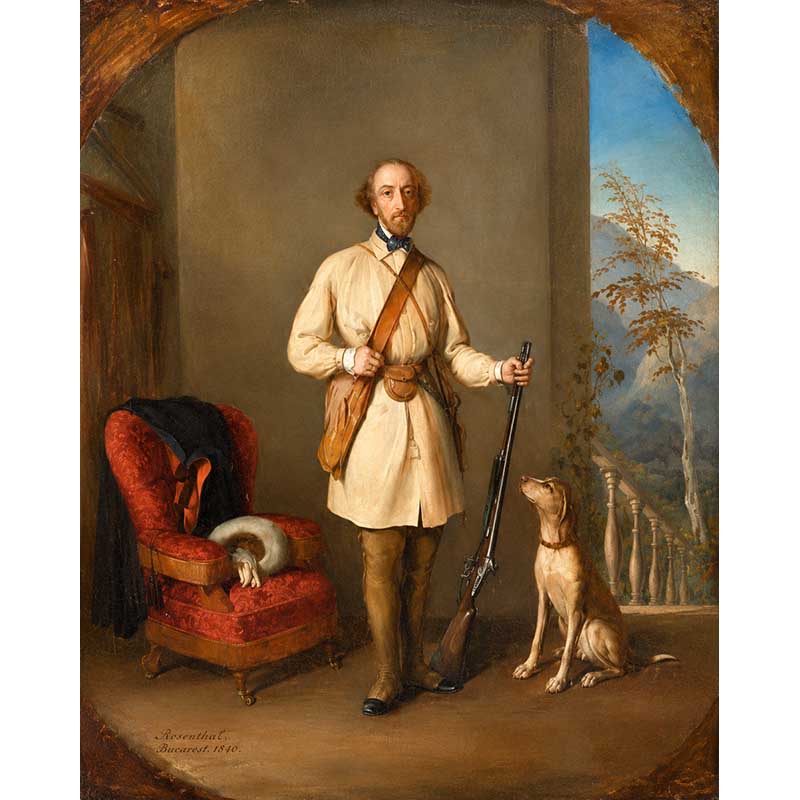
Among the goods most sought after in the Ottoman Empire were the hounds bred in Wallachia: hunting dogs, also known as quail-hounds, slender, delicate, agile, and capable of forming lasting friendships with their masters. I learned this from several documents listing gifts for Turkish officials, who were great admirers of hounds. Quail hunters believed that the poisoned noons were haunted by a spirit that only the Wallachian hound could catch. For this reason, no one set out after quail without a hound.
In any case, I had read so much about these hounds that I could easily place them in mythology, alongside the zmei. My interest began with the complaint of an arnaut, who reported that his quail-hound had disappeared. The man had a beloved dog that accompanied him on walks and hunts—one Anton, tall, whitish-gray, with human eyes.
On a Tuesday in the year 1740, Anton vanished from beside the steps, where he had been lying until then, curled like an Armenian pastry. His master—whose name had been erased, and which I did not bother to recover—was calmly smoking on the house steps, wondering to whom he might sell the fifty quail he had recently caught, when, sometime around noon, as the ghosts of boredom rose lazily from the gardens, he suddenly realized that Anton was nowhere to be seen, although the trace left by the dog’s tail, which had swept the ground, clearly proved that he had not been gone for long.
The complainant dismissed the possibility that Anton had simply wandered off: even if his mind had not been there, his eyes had gone nowhere—he would have seen, would have sensed the movement, had there been any. Under the circumstances, nothing about the situation seemed natural. Something unclean was at work, for Anton was not a dog to disappear at random. If his master whistled for him, he would come even from the mouth of a snake. Between them there was a bond more than human, and for that very reason he sensed that something grave had happened to Anton. Especially since, not long after, he saw at some distance a bird with large eyes and a blue streak beside its beak, giving the impression that it was smiling. Where has one ever seen a smiling bird? It was a demon, one of the many apparitions that haunt the noons of Bucharest.
The arnaut’s complaint was not taken seriously. The clerks at the Divan’s chancery smirked and responded with remarks that fell short of politeness. The document survived to our day by accident. In the margin of the complaint, someone had carelessly noted that Anton had eventually been found.
Around that same time, another report surfaced, equally strange. In fact, it was more of a letter, addressed to the Prince, concerning the same dog—Anton. A few days earlier, the author of the dispatch writes, a stranger appeared at my gate, a thin man with a sharp face, like a hound. Although he seemed a little short of his full wits, he could not be considered touched, mad, foolish, or even slightly deranged, with his attic on fire or anything of the sort. He was simply odd.
“My name is Anton,” he said, “and an hour ago I was a dog.”
H\e spoke with such seriousness and conviction that it was difficult to laugh at him. Although he claimed to remember where he had lived until then, he could neither identify the neighborhood nor name a single street. Apart from his own, he knew no name at all.
For several days he stayed about the courtyard and made himself useful. Most of all, he liked to sweep, and he had a style—you would have said he was dancing.
Then he disappeared, and the man never saw him again. But yesterday, the sender of the letter continues, toward evening, I encountered a dog. It was a whitish hound, rather tall, accompanied by its master, a young arnaut with a rifle on his back. I swear on my heart, says the author of the letter, that from a distance I recognized the dog as Anton, my strange visitor. First of all, he recognized me and came toward me—not to fawn, as dogs do, but to look me in the eyes. He was looking not at me, but into my brain. Is that Anton? I asked the arnaut, and he confirmed it and walked on, somewhat with his nose in the air, or so it seemed to me.
The author of the letter requested that the facts be investigated in detail, in the hope that such inquiry would reveal where the arnaut lived with Anton, his unclean hound.
The letter received no answer. It remained stuck to the back of a contract.
There the story might have ended, one incident among many wonders and disturbances of the Bucharest noons, had Eleni’s note not surfaced ten years later.
In the margin of a book, Eleni writes that something had happened to her husband one day while he was chasing quail. Proud of a net he had made himself, he went out into the stubble field, where dozens, perhaps hundreds, of quail swarmed, so easy to catch that it would have been a pity not to give a chase. Eleni kept the sack close at hand, while her husband watched the cut stalks intently. The quail moved at a mad speed in every direction. Then one appeared, slightly larger than the others, and stood still. It was an earth-colored bird, but from the crown of its head fluttered a tuft of human hair, golden.
They both stood motionless. Then the bird, which was no longer a bird, twisted like a whirlpool, and as it grew larger, becoming as great as a vortex and as great as an abyss, her husband vanished.
The field was empty, and at some distance lay the quail net. She never saw him again. And from that day on, every Saint Anton’s Day—for Anton was her husband’s name—Eleni took to writing the story on a wall, on a rag, in the margin of a book.

