Interview with Miss Edith Larch, age ninety-three, at the Larch family mansion in Pittsburgh, Pennsylvania, 1981
No, goose, I don’t talk about that.
The other things you could ask me are legion. Why, look, ask me about this room! This beautiful room where I had my beautiful childhood in this beautiful city that is, as you know, mine. Don’t you want to know about that?
Why do I sleep here? Well, where else? What a funny young miss you are, all impolitely surprised, with that goosey look. This was my bedroom, and so it is still—would you have me sleep in my mother’s? My father’s? I’ve kept both just as they were. No, this is the room that’s mine. Look, it still has all my old dolls and toys and the bed where my nurse used to sleep—now I have a different kind of nurse! Never get old, goose, never do!—and even the same carpet, that color like the mossy floor of a fairy-tale wood, don’t you think? Like ground underfoot that might turn up gemstones.
Why haven’t I changed it from the child’s bedroom it was? Because it matters, preserving things.
No, that isn’t me, the portrait. That’s my older sister. Treasured Maude. She died not long after it was painted, not even six years old. It undid us. There’s a portrait of her in every room of the house—the one in my father’s room, though, with all the flowers, was his favorite. He didn’t talk about Maude much but he put her face from that painting on all his checks, and on his business stationery, so she would always be with him even in his office, where I was never allowed to go. When he spoke her name it was like he was invoking a saint. Mother could never talk about her at all.
Me? Oh, I barely remember Maude—I was only four when she died. I have one memory of somebody bigger than me, with red hair, giving me a doll to play with, then ripping it away. The way children do.
I’ve read some accounts of Maude’s death that put it down to diphtheria or childhood infection, left vague, but I can tell you what it actually was. It was a pin she’d swallowed years before.
Well, nobody knew, not until it was too late and the wound had festered inside. A tiny thing can do a lot of harm when it’s sharp enough, and when you don’t know it’s there.
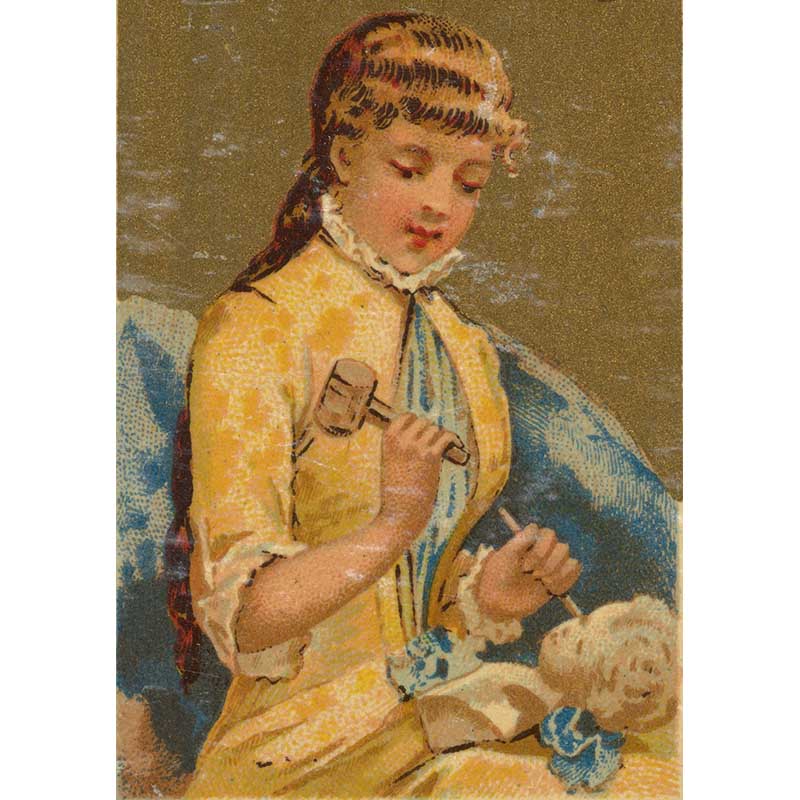
The doll from my memory is right in the corner, the one with those golden, bouncing curls. I wanted it partly because I was blond and Maude was red haired and it seemed, to my child’s sense of things, that these facts meant I should have it. I suppose I got it in the end, didn’t I? Except I never could bring myself to touch it after. I think it felt like Maude wouldn’t want me to.
I never have let anybody touch this house, so I can understand, I suppose. Even after I die—oh, don’t make that face, goose, I’m ninety-three years old and can’t get out of bed by myself, we all know what comes next—even then there won’t be a thing they can do to it. I’ve had the papers drawn up. It won’t ever get to be 1982 in here, or 1983 either. It will always be 1890, and the city will always come to visit this wellspring of itself. Because it’s from this house that it all comes, the buildings downtown and the theaters with their gold-dripping ceilings and the museums and the parks and the libraries, all the places the people in this city can go to feel small. The way people use cathedrals to feel small before God. You people have no idea how lucky you are to be able to find that feeling in the course of your day, just slip out of your tiny cramped offices and into spaces as giant and tender as God’s hand. It’s my father who gave that to you.
And we’re seeing now what happens when people let go of these largest things, when they let the steel and the coke leave. The tide will turn back, though.
What’s that smirk, goose? You disagree?
Well even if you’re right, you’ll have my father’s bones to build on when you figure out what will come after.
You’re going to keep asking, aren’t you? You young, young goose, you of the smirk and the snicker, you who have not the faintest, foggiest idea. Here’s what you must understand, if you really want to know anything about what that year was like: Maude had only just died. Just ten months before. My mother’s room—they took her in there to die—still rang with her screaming. I’ve wondered sometimes if that’s why my mother never seemed to sleep again. In the night when I was a teenager, I’d wake up desperate for a big, frothy cup of milk, a piece of spongy bread to sink my teeth into, and when I left my room in the dark, half the time I’d find my mother roaming the halls like a ghost in layers of filmy white nightclothes, and she’d look at me as if she couldn’t remember who I was.
I’m getting to it. You have no patience—another rudeness. Maybe you’ll learn with time. Time is a teacher that way, though not a kind one.
Maude was newly dead, and my ruined mother had just had another baby, and she’d had him too early. There’d been talk for months about how my new brother or sister was coming—it was the only thing my parents seemed able to say to me. But he was born almost a month before he should have been, my brother. That was, in those days, too much.
He lived for that month. There was a flurry of bringing in of doctors and nurses and healers of various stripes, which they’d tried with Maude too. It all felt like another turn around the same track, as if we were caught inside the same story.
And that Persephone month when we lived in the underworld again, having descended for the second time, that was the month of the strike.
Do you think it was an accident? I don’t. I never have.
Oh, I can see you don’t like that. Goose, your face is like the face of this city, my birthright city, it’s completely transparent to me. You’re thinking I’m heartless now as my father was heartless then. But who are you to say, I wonder?
It was a hot summer. The air was so thick in those days with smoke that when it got humid nobody could breathe. The air was like a hot blanket, not just over but also inside you, creeping its way into your throat to stuff it. The heat drove those men mad, I think.
We could feel it in the air even way up here, even through the thick, stinking fog of our grief. My mother and I, we sensed that terror, and we breathed a sigh of relief when my father walked through the door shouting for us and proved himself safe.
Of course I know there were others who weren’t safe that day. Who are you to call me unfeeling, you who’ve come here to berate an old lady in her bed?
Goose, there’s something about your face—you look familiar to me, now that I look at you properly. I just can’t quite place you. You make me think of someone I met once, long ago, in some dream.
Anyway, it was resolved in the end.
There was a price, though. I’ve always thought the strike killed my brother as much as anything, that he must have felt its jolt and been unequal to it. It pushed his pin through. That’s what I think. I’ve had nightmares my whole life that I go to unwrap the blurry bundle that’s all I can remember of my brother and there it is, that pin, sharp and clear, sticking right through his side.
He has no face, in the dream. It’s not like with Maude. Maude with the sun always in her hair. (That was its color, it carried the sun in it.)
And we hadn’t even had the baby’s funeral when the man came for my father. That assassin who shot my father twice, in the arm and in the throat—the very throat.
No, I haven’t see his picture. What a question.
You’ve brought it? Now why would you do that?
I suppose I hadn’t realized he was so young.
No, I will not look into the eyes. I don’t like them. I don’t like the way they look at me, that sleepy self-satisfaction, how dark they are, how full of dreams.
You can’t make me.
I don’t know who you are, goose, but you can’t.
Your own face, is it changing?
You take this back, you should never have brought it here. We thought my father would die. They laid him out in his bedroom, right across the hall there, and our house took on again a funereal stillness. A child feels that kind of thing in the air. It changes the way that child breathes after, even just once, and remember this was my third trip into the underworld.
I waited for my father’s own pin to work its way through his side. Any minute now it would show itself, and I’d be called in to prick my finger.
But my father didn’t die, and didn’t die, and after a week or two he was up again, in his dressing gown, doing some work in his study across the hall. Another week or two after that he was back at his office downtown. There hadn’t even been time to get out the bloodstains.
He told us Maude had come to him, just before the assassin entered his office, to warn him, to shove him down, and that’s why he survived.
Though I always thought, But he got you in the throat, Father, how far down can you have been?
A terrible thing happened one night after my father was upright but while he was still housebound. He was in his green silk dressing gown, and we were sitting at the table. Our suppers were often late and long, and I had to be there for the whole of them, flattened by the awful weight of time in that room.
Suddenly my mother’s fork and knife clattered to her plate. The sound was loud, but her face was not surprised, it was furious, fixed on my father.
“Why are you alive?” she said.
My father said, “What?” Maybe he thought he hadn’t heard her.
“They shot you in the neck. There wasn’t a thing wrong with the baby, and what was Maude’s pin to a bullet? But they died, both of them died, and here you are.”
My father stared at her. He was using his icy eyes the way he did in necessary moments. “Cecily.”
“Did you bargain them away, Will?”
My father widened the ice of his gaze. He lifted a delicate bell he kept by his plate and rang it, a sound too that was like the ringing of fine ice. To the servant who came, he said, “Please send in Mrs. Larch’s maid.”
I can’t remember what happened with supper after. I do remember wondering why he didn’t just tell her that he never would have made such a bargain, would, in fact, have sold himself or any of us to buy back Maude.
Oh, of course, baby William too.
I don’t know why I said only Maude.
Goose, you actually remind me a little of her, did you know that?
My father wouldn’t die for years and years. It was slow, in his bed in New York. It was horrible to watch. His mind was all tangled. He seemed to think the man had come to kill him again. “Edie, don’t you let him in,” he kept calling to me, clutching my arm. There were only the two of us, by then.
You’ve brought something else? Oh, that portrait. I was eighteen, and somebody thought a double portrait a fine idea. Everybody talks about the composition, how I’m like my father’s shadow, both of us in profile, him in the foreground, me in the background, but the painter didn’t seem that thoughtful. And I’m in bright white, my father in dark gray, and that’s not the way a shadow works, is it.
I don’t need to look closer. I’ve never liked the way my face looks in this painting, so open, fragile in a way I don’t remember feeling. Anyway, I’ve seen it many times before.
Have you done something to this copy?
What is that, behind me?
Who?
That smear of brightness—now that I look, it has a shape, and the shape is a face’s shape, beneath that haze of hair, which has the brightness of the sun behind a dirty cloud. Each strand glinting like pins.
Do I trail her always, my sharp and shining ghost? Why would she stay, what does she want?
I suppose the life she didn’t get, and that I got instead.
Because I know, I’ve always known, the pin that took two years to kill her was a pin from my diaper. No one ever told me, but I seem to have heard the truth in all the quiet. Maybe I pulled it out myself and threw it on the floor.
Maybe I even pulled it out and put it in her hand, like a coin, like a magic, poison seed. Maybe I knew it could hurt her. Wanted, somewhere in my infant brain, something to dim the fire of that hair, the sun in my parents’ eyes, which would have meant that had she lived they never, ever would have seen me. It feels possible I could have wanted that. Not knowing how her death would kill my life.
It must have been something for her, to bear the weight of that color through the world.
A color like the color of your hair, goose.
Was that your hair’s color when you came into my room?
How long have you been with me?
Take anything you want. Touch everything, change anything. It has all, always, been yours. I gave you all the rest of it when I gave you the pin, didn’t I?
Though somehow now I have that pin back again. Here, feel, now. It’s almost through.

