My junior year of high school, the building we had all been in for three years and counting was for sale. Two gyms, fifty-two rooms, administrative offices, fourteen bathrooms, and lockers that extended to the horizon. By homecoming there were rumors of potential buyers moving in guided clumps down the wide halls, seeing . . . what? A sock factory? Artist lofts, if you don’t need a second floor for something to be a “loft” but like the idea of the cafeteria being an exhibition space? A seed warehouse, if not too many of the classroom walls are load-bearing, can be knocked down to allow for more open space? The student body was admonished over the PA to “be neat,” to refrain from our in-built tendencies to vandalize, to please stop leaving cigarette butts and beer bottles in the parking lot.
This, of course, was, for some, an invitation to destroy, a license to litter. However, there were those among us for whom this eventual sale triggered a certain nostalgia we could never so much as whisper, not without suffering banishment from whatever social circle we’d edged into. “Care about this place? What, are you some kind of loser?”
No.
But isn’t this where Mary Cadonis threw up that time, before she turned up really sick and never came back? Isn’t that where the pinkie of your crush’s hand brushed yours between classes, and you held that hand secret under your leg all through English? And that’s where Ian spilled all the mercury that time, and Mr. Brown, the chem teacher, placed his body and his out-held arms between this danger and his class, to keep them safe.
I was one of those bodies he was holding back.
And now that place where he had showed us what a real teacher was made of, it was going to be storage, or an office, or I didn’t know, couldn’t guess.
Our futures and our school’s future were diverging, but, while we would keep going, this building that had held us all through so many trials and tribulations, it was being left behind, would never be the same again. And were we even going to look back over our shoulders at it? Were we ever going to say the right kind of farewell, placing our foreheads to its bricks and thanking it for its service?
Probably not, no.
Some of us would continue our education elsewhere, never think of this place again, and just . . . just go on to unguessed-at lives not remotely in keeping with our parents’, as we’d been promising ourselves. But others of us would be issued a time card within a mile of the parking lot and then drive by this same building for the next forty years, still seeing shadows of ourselves in the parking lot, leaning back to blow perfect lines of smoke up to—or at—the heavens, exactly like this moment, and who we were then, was going to last forever.
And some of us, the quiet ones, the scared ones, the ones who timed our entrances into the cafeteria and pep rallies so as to draw the least amount of attention, we harbored a different possibility in our chests, in the hesitant tilt of our lips, in our . . . in our poetic sensibilities? That’s the only thing to call it, really, what was surging in me that year.
I can still feel it, can still taste it. Part of me’s still there.
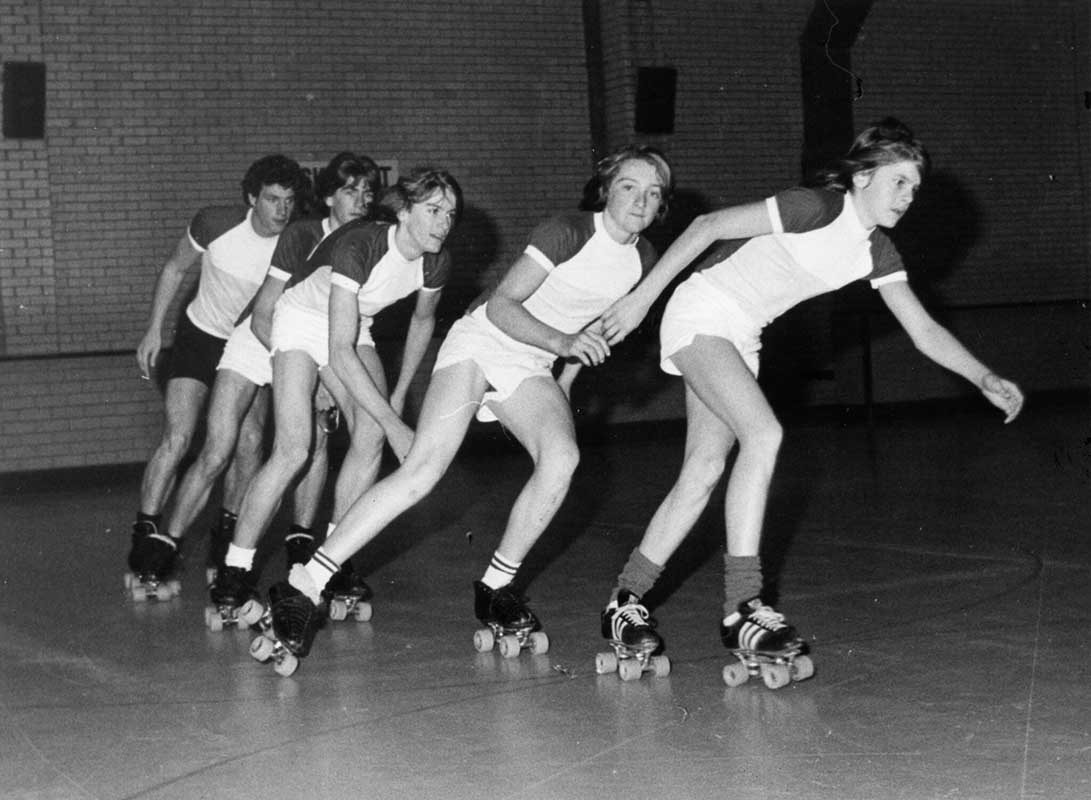
Walking with a note from the assistant principal to the history teacher, alone and hopefully unobserved in the halls, I would sometimes let the soles of my shoes slide one past the other on the smooth concrete floor, and imagine that what this hallowed, historic building was going to be was a vast, labyrinthine skating complex—a rink, a palace, a winding and magical place where you pay at the front door and follow the arrows directing traffic.
The first weekend would be packed, everyone in town here to witness this transformation, but over the coming weeks, numbers would dwindle, and our old school building would become a refuge for those of us with no group dinner to participate in on a Friday night, no party to get a six-pack for on Saturday.
That makes it sound sad, but these Friday and Saturday nights skating the hallways would be a reunion, really. One there would be no talking at, no chatter, no catching up, only nods in passing, which would themselves just be acknowledgment that this is what we do now, yes. This is where we are—who we are.
And?
Over the months, the halls and lockers resigned to the sound of our clattering wheels, wouldn’t a certain . . . lore surface? coalesce?
It would, yes.
There would come the suspicion that if we skated fast enough, headlong enough, our hands in tight enough fists, arms pumping, then, in our briefest, most smeary peripheral vision, we would see in the classroom doorways sliding past students in the jeans and haircuts of a different era. In return, every great once in a while those students trapped in History or Algebra or detention, they would get a sense of us out here, a future blurring past, our gazes so intent, our bodies leaned forward, and—
And wouldn’t you, sitting in Geography, sensing that, lose your breath a little? Feel that good hollowness in your chest? And then know in that way only a junior in high school can that there’s a whole world out there waiting, if you can just step into that race?
That’s who I am, out here in the hall, my laces tied tight to give me more ankle support, because I know the kind of ankles I have.
But that doesn’t mean I can’t fly.
My glasses are goggles, there’s a sheen of sweat on my skin, and if I lose concentration for even an instant, the spell will be broken and some student in Trig will be marooned there, trapped in that classroom forever, perhaps to be sold along with the building, packed in the coffin a locker is, the lock spun, the combination already forgotten, nobody at the front desk anymore to keep track of that kind of stuff.
There are those of us who won’t let that happen, though—who will never let that happen. We skate faster and faster through this rink, this palace, this cathedral, this winding labyrinth of hallways, of memories, of possibility, and I would say that we clock out at the end of the night, slouch home, rest at last, but with a calling like this, you never really stop, do you?
No, you don’t.
You skate faster and faster, harder and harder.
The life you’re saving there in Sociology, in detention, it might be your own.
And if you go fast enough in the night’s circuit, you might even see your older self as well, skating just ahead, always just out of reach, too intent on the future and this mission to ever show their face, so you can see what you might look like in a decade.
It’s why, back then, all this swirling in my head, in my heart—
my whole future, I mean—it’s why the assistant principal always called on me to deliver notes to various teachers through the day.
I didn’t dawdle, I’m saying.
You could even say I flew, my hands clenched into fists, my head tilted back to keep my tears in.

