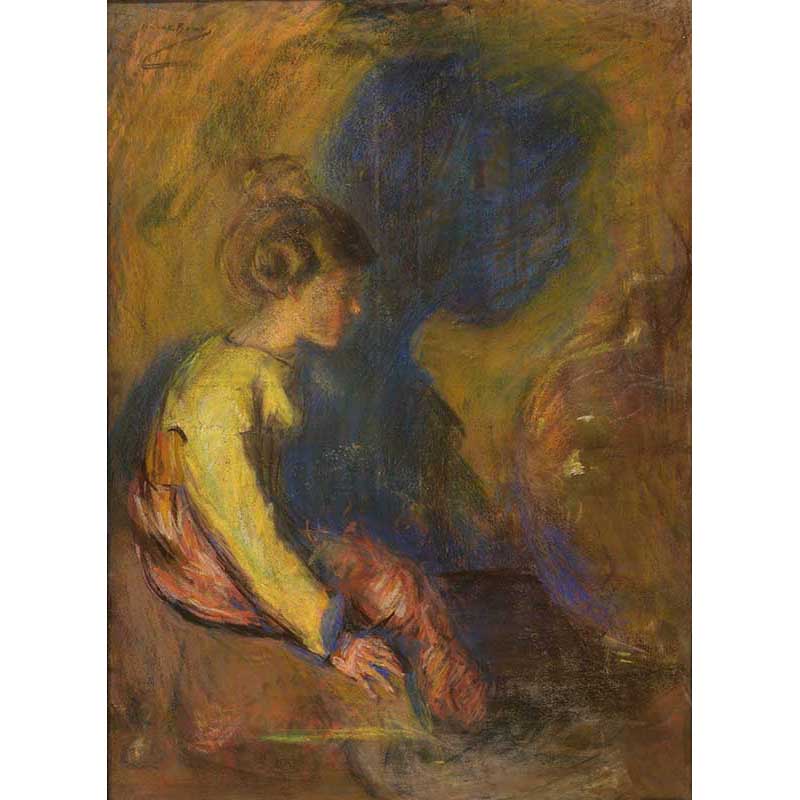
Alice Pike Barney, The Shadow, n.d. Smithsonian American Art Museum.
Over the course of what would turn out to be my wife Tilda’s last week, she—there’s no other way to say, so I’ll just say it: she started seeing herself out of the corner of her eye, around corners and the like. Not so much in reflections, though that was my first suggestion to explain this thing happening to her. We were having work done around the house, thanks to the thirty thousand she’d inherited from her mom’s passing, so all our mirrors and windows were . . . not set up to scare us, but you could definitely be momentarily startled, seeing yourself through a fog of hanging plastic, captured for a moment in the thin glass of a framed photo, a random encounter with yourself that, no matter how many times you backed up and repeated your passing, was never quite possible to replicate.
As it turned out, though, this wasn’t only happening to her in our hallways, or the many stages of our kitchen.
This ghost—I don’t know what else to call it—was also stalking her at work, she said.
To try to convince her nothing was wrong, I did that thing she, afterward, not mad so much as disappointed, told me men are always doing to women: appealed to reason. As opposed to “emotion,” sure, I’ll be that guy. I am that guy, I guess. I can say that now that she’s gone. Maybe I’m saying that because she’s gone, even, like falling on my own sword—I’m not unaware of the phallic association—will somehow cleanse my actions.
I did do it out of care for her well-being, anyway. Does that count in my favor?
Probably not, I know.
What I did was stop by her office during lunch and have a confidential talk with Security, this guy whose name I always have to catch again from the badge on his shirt. The evening before, when I’d asked Tilda if she’d left the hallway lights on for a reason, leaving a line of dots after that just like my dad used to, she’d turned around slowly on the yoga ball she sits on at home, her knees up under her chin, and told me that she was seeing it at work now too.
The way she told it, she was coming back from the mail drop by the front door to their suite when she didn’t hear so much as “sense” a presence behind her. At which point she did what you do, if you don’t want to spend the rest of your life spinning around in your tracks, trying to catch secret pursuers: she set her jaw, wrapped her hands into fists, steeled her backbone, and walked mechanically to the turn that led into her wing.
Standing at that intersection, though, was a coworker she was friendly with, who nodded her head up in greeting—this was maybe two hours after lunch—but then, unaccountably, this coworker let her coffee mug slip from her fingers, and didn’t seem to even be aware that she’d let go.
More by reflex than anything intentional, probably in no small part due to the shooter training her whole office had had to work through the previous week, Tilda turned around, ready to duck and cover.
What she saw was a woman walking into Dave Masterson’s glass-walled office—or, what she actually saw was the black heel of a sling shoe just like her own, slipping through the doorway. And Dave Masterson’s office is basically an aquarium, a phone booth, is from when the whole floor was a call center, ramrodded by one supervisor in this office, who needed a clear line of sight on all his would-be-slacker employees.
“What?” Tilda said to . . . I can’t recall this coworker’s name. “Grace,” say.
“I—I—,” Grace stammered, backing away from her shattered cup and spilled coffee.
Tilda, being Tilda, knelt to gather the wet shards into a pile. There were two or three looky-loos by now, always up for some office drama.
“It was . . . it was you,” Grace said, her fingertips to her chest.
“Is my hair—?” Tilda asked, trying to make light of whatever was going on, but Grace wasn’t smiling.
“Behind you,” she said. “It was . . . it was you, T.”
That’s what I called her, but surely I wasn’t the only one. Or maybe that’s me calling her that here; it’s hard to tell anymore.
Tilda stood, sort of gathering the shards, the spill, and inspected the wide aisle she’d just come up, one package lighter than she’d been thirty seconds before.
“Me?” she asked.
And of course her casual inspection of Dave Masterson’s glass-walled office turned up no one, not even Dave. Worse—Tilda’s word—the light in his office was off. When the lights in that whole suite are all motion activated, to save energy.
“If someone had just walked in there, the light should have still been on,” Tilda said to me. “Right?”
I was still standing in the doorway of the guest bedroom she was sitting in.
“Déjà vu or something, probably,” I said, shrugging it off.
“In the eyes?” she asked.
“Does Grace wear glasses?” I asked back. “Does she drink? At lunch?” Tilda didn’t dignify this but, without quite saying so, I had a sense why she had left the hallway light on. I didn’t press it—it wasn’t worth the nickel or dime the extra electricity would cost.
But, because nickels and dimes add up, over my lunch the next day I had Security in her building pull up their feed from the part of the suite Tilda had, apparently, been shadowed in by herself—according to “Grace,” whom I already wasn’t trusting.
“Can I?” I asked the guy in the chair, his name tag annoyingly facing away from me, and when he raised his hands from the scroll-wheel, I scrubbed the recording back and forth, slowing down each of Tilda’s steps as she approached the junction.
“What?” Security asked, palming an earbud away, leaning in to see closer.
“I don’t know,” I told him, and edged the ball ahead, not watching Tilda so much as a few steps behind her.
There was nothing.
On second replay, though, there was Grace. Her startled reaction. That coffee mug making its pixelated fall. From . . . just one Tilda, not two.
“Does Custodial know about this?” Security asked—the spilled coffee.
“Thanks,” I told him, and made my exit, was waiting in the lobby when Tilda came back in from lunch. She liked to eat in the park, I even knew what bench, but I was worried that seeing me making my way across to her might unmoor her in some essential way, as if I were the reluctant bearer of bad news.
But I guess I was anyway.
Instead of having it out in the lobby, we took it to the parking garage, where I told her, controlling my voice very well, that maybe the pressure from the remodel was just stressing her as much as it was stressing me, which all led to . . . finally having to admit that I’d been in her building to disprove her story, to make it such that she was the crazy one here, not the world.
It wasn’t my best moment, and I feel even worse about it now.
I couldn’t have known then, though.
Two nights later, not quite reconciled from the parking-garage fight yet, I was watching a show Tilda despised when she passed in the hall, barefoot and in her sleep pants and the chemise she wears at night.
“T?” I called after her.
Nothing.
I caught up with her at the refrigerator, which, due to the work being done in the kitchen, was in the garage.
The light pushing past the milk and orange juice and leftovers was making her front side glow, resulting in a sort of haze of angel light around her, and, my body overriding my too-slow mind, I reeled back, at least in my head, in my chest: she was standing in the open doorway of another dimension, wasn’t she? Or . . . or she was tranced out at the door of an alien ship. Something. Just a weird visual moment, I told myself. But that didn’t make it feel any less wrong.
“Hungry?” I called ahead, announcing myself because I knew this was a spooky week for her.
“Hey,” she said, not turning around, her affect flat like maybe she was sleepwalking, and I sidled up behind her, my hands finding her hips, my chin on her shoulder.
She ran her left hand up the side of my face and left it there, holding us together. It made me feel like we were in a movie, made me want to look around for the camera, for a whole crew out there in the darkness of the garage, documenting this meaningful moment, this unexpected rendezvous, this next nice moment in what was surely going to be a long and happy marriage.
“I’m sorry,” I muttered into her neck, getting a sense where this was going, or where it could go, and, using the hand already touching my face, she crossed my lips with a finger, then brought her mouth around to mine, and there in the steady light of the refrigerator, with a whole imaginary film crew watching, we took off what clothes we needed to to do what was suddenly so urgent to be doing.
Afterward, leaning on one arm on the refrigerator, I looked over to the doorway to the kitchen I’d left open, and—
“Bryce?” Tilda said.
She was standing in the doorway, rubbing sleep from her eyes.
I looked back around to the garage where there was no car parked, and I honestly don’t know how far back that inky darkness went, how deep it was. What chasm I was teetering over.
I shut the door, came to bed, leaving the television flickering in the living room, my bourbon in there hardly even touched.
The next morning at work, I used some of our 3D modeling software to, with my screen tilted away for privacy—our office is an open office—wireframe Tilda and me at the refrigerator, me behind her, her hand cupping my cheek.
What I was interested in was how many joints her fingers, hand, or wrist might need in order to shush me as she’d most definitely done.
I stopped when the arm on my screen stopped being as human as I knew it had to be.
Over dinner that night, I don’t remember exactly what, I tried to gauge whether we were reconciled, or if I only thought we were.
“I talked to her,” Tilda said, no prompting.
“Her?” I asked.
It was spaghetti. I’d made it.
I remember now because she was twirling it on her fork not like she wanted to eat it but like she wanted to watch it, solve it.
“The other me,” she said back so simply, not flicking her eyes up to see what mine might tell her.
“The one Grace saw,” I confirmed, my tone dropping a register, to signal what land we were leaving, which one we were broaching into.
Tilda nodded, rotated her fork the other way, unwinding the noodles. For some reason that filled me with rage.
“The one I’ve been seeing here,” she said, opening her other hand to encompass our whole place. “And at work. And on the subway the other day, I didn’t tell you about that one.”
“I told you,” I said. “This remodel—”
“She’s real,” Tilda interrupted.
“Real like you say she’s real,” I said, choosing my words carefully, “or real like she can hold a palmful of ball bearings.”
I don’t know where I came up with that. I think it’s from an animation project a few years back, a proof-of-concept thing, but I can’t say for sure which one.
It didn’t matter either. What did was the emphasis I’d been unable to keep out of my delivery, hitting that “say” hard like that. Couples are especially attuned to exactly those type inflections.
Tilda didn’t sigh, didn’t slam her plate—of the two of us, I was the juvenile one, I know—but she did stand, walk into the kitchen without looking at me, leaving her fork standing in the uneaten spaghetti on her plate.
Of course I followed.
All around us was plastic sheeting. By then we’d given up trying to suss out what stage of completeness the remodel was mired in.
Tilda was leaning against the counter in front of what was going to be the sink.
She led off with, “Just because there’s not a recording doesn’t mean it didn’t happen.”
“The proof is your memory then,” I said, very calmly. “Your . . . your testimony.”
“This is a marriage, not a court of law,” she informed me, which felt very much like an objection. Just one I couldn’t call out.
“Did we or didn’t we have sex in the garage like it was a college party the other night?” I asked.
She studied me.
“Is that why you were talking about ball bearings?” she asked.
I winced, squinted, breathed in deep.
“What did the other you say?” I asked then. Bryce the Tolerant asked. So tolerantly.
“So you believe Grace?” she asked. “You’ll believe a third party, but not—”
“If you saw you saw her, then you saw her,” I said.
“I mean, I didn’t see her see her,” she said back, without much oomph to it. Or she was saying it like she knew what it sounded like.
“But you talked to her,” I went on, trying to make sense.
“I was putting my makeup on this morning,” she said.
“This happened before you went to work?” I asked, insulted.
“You were already gone, Bryce.”
I just stared at her shins. Even when we were arguing, I had always been my full name, never my first letter, like I reduced her to—affectionately reduced her to. It wasn’t an act of violence, but a term of endearment. I stand by that.
“I was doing my makeup,” she said, “and I . . . I had a sense she was out there. In the bedroom.”
“Just waiting?” I asked.
“That’s what I asked her,” Tilda said. “I said, ‘What are you doing out there?’”
“She answered?”
“She says she has to, that—that she has to wait, to always be close.”
“To you.”
“To me.”
“Because . . . she’s your guardian angel?” I asked, incredulous beyond incredulous to even be entertaining this.
“Because she’s me,” Tilda said—confessed, I should say. That’s what her tone and affect were.
“But she’s you while you’re also you?” I asked. “Just clarifying, not making fun.”
“Thank you,” she said. Which I’m not sure she meant.
“This happens sometimes, she says.”
“You said,” I repeated. “To you. While standing in front of the mirror.”
“She says that sometimes they show up too early, or we stay too late.”
“The pronoun situation here—”
“Just listen, Bryce? When we die, when something happens to us, I don’t know, we, like, separate from ourselves? Separate and move on.”
“She’s your soul,” I said, my voice dripping with obviousness. “Your spirit, your ghost.”
“Something like that.”
“Wait, wait,” I said, holding my index and middle fingers to my temple in extreme concentration, or the mockery of it, “forget all this ‘the afterlife is real’ stuff, who cares about that.”
I looked up to her in honest wonder.
“What?” she said, looking around the kitchen. “You’re scaring me, Bryce.”
“Not as much as you’re scaring me, T,” I said. “If your ghost is, I don’t know, an early bird, a line cutter, then . . . then that means you’re about to die?”
Tilda pressed her lips together, her eyes full.
I pulled her into my arms, could feel how scared she was. How hard she was trying to hold it together.
“Don’t,” I told her. “Tell her to . . . here, I’ll do it. Hey, Tilda’s ghost! We don’t want you here! My wife isn’t dying, or going to die, do you hear me? Just, I don’t know, go back to wherever, cool? Just wait, please.” This next part to Tilda: “We’ve still got a lot of years, don’t we? Isn’t that what we promised? To grow old together, have rocking-chair races or whatever?”
Which is when the dam broke, for Tilda.
We held each other, we fell to our knees in our incomplete kitchen and we hugged and the spaghetti hardened even more on the dining-room table and I didn’t tell her what I knew then to be true, that she was having suicidal ideations, and she was expressing them in this way, via supernatural mechanics gone awry, a topsy-turvy world chewing her up.
But?
What I also thought, what I couldn’t help but think, was: Suicide? Why? Wasn’t her life perfect, or close enough?
Because that’s how suicide works, yes, Bryce. It’s an equation balanced on both sides, this big pro and con thing. It’s never just suddenly there as the best option, surprise.
And, no, Tilda didn’t kill herself.
I was wrong about that.
That night I woke to an empty bed.
Where I finally found Tilda was sleeping in a corner of the hallway closet. She’d been chewing on the collar of her chemise long enough that it was dark with wetness. She’d been chewing and crying.
I wriggled in beside her, held her hand, and immediately felt guilty for wondering how long this was going to take, since I suddenly needed to pee in the worst way.
“I don’t know what’s happening,” she told me, her chest hitching to say this out loud.
My knee-jerk reaction to this was that of course she knew—hadn’t she told herself? But then I realized that if she didn’t “know,” then that meant she was doubting that . . . that whatever it had been in the bedroom the morning before. Conversation, for lack of a better way to say it.
“Does she, you, know how?” I asked—how she was supposed to be dying.
“It doesn’t matter if I know,” Tilda said. “Knowing doesn’t change anything.”
“I want to see her,” I said finally.
As if pulled on strings, Tilda stood into the winter jackets, using the vacuum cleaner to support herself, her other hand twined in mine.
We stepped out of the hallway together.
I looked up one way, down the other.
“Like this,” Tilda said, and led me down toward the living room, which sounds like a joke, this being the story of her death, but it isn’t.
I breathed in sharply when I heard the plastic sheeting behind us . . . rasp? Like someone had run their fingertips along its stiffness.
“Hello,” Tilda said.
I started to turn around, but she pulled my arm hard enough to stop me.
The Tilda behind us, if in fact we weren’t alone, didn’t respond. But that was just it: it felt like she, or “she,” was very intentionally, very consciously not responding.
I could feel eyes on my back.
“Don’t do this,” I said ahead of us, loud enough that anyone behind would clearly hear.
“She doesn’t want to,” Tilda said.
“You don’t want to,” I corrected, and by the time she shrugged, I was already turning, grabbing exactly that plastic sheeting that had made the noise and leading with it like a cape, like a blanket, tackling the very corporeal form in the hallway and holding her down like she was on fire, like she needed me to be suffocating her.
“Give me something, give me something!” I called to Tilda, behind me, and when she wouldn’t, I reached around until I came back with a hammer the remodel crew was always leaving around.
It was precisely what I needed.
My first swing was timid, civilized, only coughed a little blood up onto the back side of that plastic, but the next and the next and the next were harder, deeper, more savage, until the downstairs neighbors hit their ceiling with the broomstick they kept specifically for that.
I was breathing hard and crying by the time it was done.
When I turned to Tilda, she was gone.
On the couch, I knew, her feet up under her, her arms hugging her legs to her chest.
Fine, fine, good, I told myself.
I propped her surpassingly heavy ghost up in the hallway closet she had been crying in, then washed my face hard in the guest bathroom. I looked at myself in the mirror, and I finally nodded that this was the only way, the only thing.
That lasted about twenty seconds. The enormity of what I’d done—what I told myself I’d had to do—was crashing down on me, driving me to my knees. I was crying harder than I ever had, like maybe souls were real, real enough I could throw mine up, stretch it like taffy between my fingers until I found the essential flaw, and use my teeth to tear it away, spit it out, grind it into the carpet.
Finally, Tilda placed her hand on my shoulder, pulled me back into the world. Into life, and living.
“Bed,” she said, and I nodded, and she led me there, and at some point in her holding my face to her chest and smoothing my hair back, her chemise wet with my tears, wet and transparent, well, we remembered what the marriage bed is for. We were trying to hide in each other, I think, and it sort of worked. I slept, I mean. I slept when sleep was the most impossible thing I could imagine.
In the morning, my coffee brewing, I stood in front of the hallway closet for what felt like a lifetime.
And then I looked in.
Tilda was still there behind the bloodied plastic, her eyes and mouth open.
The smell was very real.
I fell back against the wall, didn’t know what was next, what could be next, and walked on zombie legs to the bedroom. I’d meant to step into the master bath, ask Tilda what now—I could hear her makeup ritual in there—but then I stopped just shy of her reflection coming through the doorway.
“T?” I asked, barely loud enough.
When there was no answer, I asked again, and then I flinched ahead and swayed my back away from the danger of the coffee maker doing its thrushy whoosh in the kitchen, announcing it was done.
That delivered me far enough into the bedroom to see that the bathroom was empty.
I turned to run and ran right into Tilda, coming from the kitchen with my coffee.
It spilled all over both of us and we spilled onto the floor.
“B?” she asked, not worried about her work clothes, the carpet, the mug.
I looked up to her, blinking.
The reason I called her T was because, I’d always joked, I didn’t know how to do the Charlie Brown lips her name was shaped like—the tilde. It was a bad joke I’d made years ago and stuck with, and, in return, Tilda always insisted on using my full name.
Until now.
Until I killed her, trying to save her life. Until she wasn’t herself anymore, except she also was.
“Go, go,” she said, shooing me back into the bedroom, “I’ll clean up out here,” and I was all the way at the hand towel hanging above my sink before I heard the closet hallway door open, then, softly, shut.
Tilda was, in her words, “cleaning up.”
Leaving me here, in this marriage, this life, living with a woman I don’t know for certain is a ghost, but I don’t for certain is the woman I married either.
Signed, B.

