THE CITY OF OLAM
Chief among the points of contention in the scholarship devoted to the city of Olam—a city which, according to what ancient reports have survived, fell into ruin at about the time of the Babylonian Exile—are the following two: the precise location of the city, and the reason for its downfall.
Quadratus of Volubilis, in the third volume of the Fides Antiquorum (his catalogue of ancient Jewish sects), confidently asserts that the city of Olam lay somewhere between Nineveh and Rhaga, and was eventually sacked by hordes of deserters from the Median army. Ahenobarbus, by contrast, places the city to the north of Tarsus, and declares (without any citation) that it was destroyed by wildfires. Flavius Josephus, in his Antiquities, speculates that there must have been two cities by the name of Olam—one built, as it were, upon the ruins of the other.
Josephusʼs account is the most captivating one. According to his telling of it, the king who finally assumed power in the first Olam—a man known only as Moreh (“teacher”), because of the way he assigned himself the responsibility of moral instruction—took very seriously the longevity of such figures as Adam and Noah and Methuselah.* Moreh inferred a rudimentary principle from those great lives: if our human lifespan is much shorter now than it was for men of yore, it is because we have fallen farther from God. The king issued a simple proclamation: Only the wicked die.
Ruin followed. Enemies began murdering one another, trying to prove the wickedness of their foes. Husbands and wives who wanted divorce simply did away with their spouses, and felt justified. Political rivals no longer bothered with debate or even contumely, but instead resorted to murder in order to discredit their opponents. And so did the city perish, as it were by its own hand.
The second Olam, according to Josephus, came to be led by a new king, one calling himself—audaciously (and blasphemously, from Josephusʼs perspective)—Torah, or “teaching.” Likely wanting to avoid the fate of the first Olam, the king promptly circulated the opposite decree: Death befalls the good, and only them. Predictably, the result was the same: wives murdered their husbands (and vice versa), and children were slaughtered. Suicide became supremely fashionable. All to prove the goodness of the deceased.
It requires no philosophical ingenuity to see that the two cities were one and the same. The fates they suffered were identical (or at least were mirror images of one another); their respective devastations arose from a single essence. Indeed, the fate of the city of Olam is the same as that which will hunt us down should ever we elect to revive its elemental error, to wit: the attribution of a moral significance to death.
___
* Josephus himself accepted the long lives of biblical patriarchs as literal truth. From Antiquities of the Jews: “let no one, upon comparing the lives of the ancients with our lives, and with the few years which we now live, think that what we have said of them is false; or make the shortness of our lives at present an argument that neither did they attain to so long a duration of life; for those ancients were beloved of God and more earlier made; and because their food was then fitter for the prolongation of life…”
ALL LOVE IS ABSTRACTION
I will tell you two tales. Both are apocryphal; both involve a severed head. In fact, the two stories are one and the same.
According to legend—a golden one, if the Middle Ages are to be believed—Saint Irenaeus of Lyons was martyred by decapitation at the beginning of the third century CE, in Lugdunum in Gaul. In accord with orders from the emperor Severus, Irenaeus’s head was brought to Alexandria, where, marvelously, it began to speak, preaching a sermon on the topic of bodily resurrection. When Christ returned to life, he ate broiled fish, or so the head repeated like a refrain. Severus, whose faculties already had been impaired as a result of illness, sat furious before the head of the martyr, and at once ordered a tax be levied on all the fishmongers in Galilee.
It is only in passing that Saint Jerome, in his Life of Paul of Thebes, mentions the satyr that had been captured and brought to Egypt, only a hundred or so years after the death of Irenaeus: “For a horned man was brought to Alexandria, and he was a spectacle to all who saw him.” A less reputable source furnishes some of the more bizarre details surrounding this event, claiming that the creature that had been taken captive was none other than Silenus, son of Pan, preceptor to young Bacchus and the very best of the satyrs—this, his noble pedigree, having been proven by the fact that his head continued to speak (and cheerfully, holding forth on the subject of human greed) for several days after the emperor, Constantine, ordered it removed from his body.
Pseudo-Eusebius of Cremona is often credited with this second, more lavish version of the tale—an authorship which, for most Christian historians anyway, is reason enough to discard it, root and branch, as spurious. But I tell you, oh skeptical readers: it is the true account (as is the aforementioned story of Irenaeus), for in it lies a great symbol.
Severed heads that speak abound in human legend, to be sure. There is the example of Orpheus, whose head, torn free by the Thracian women and then cast into the Hebrus River, continued to sing lovingly of Eurydice all the way to the Aegean Sea. There is Saint Denis, the cephalophore, martyred in the third century, who took into his hands his own head after being decapitated, and walked for miles while preaching a sermon on the subject of repentance. Such images symbolize resistance to power: they represent what even governments cannot destroy, what survives the body even in death: art, song, speech, truth, writing, ideas, wisdom. They are symbols, that is to say, of the triumph of abstraction, that real afterlife: symbols of symbolism itself.
But, because a symbol that refers only to itself spoils its own climax, and because there is truth in that saying of the Cathars, that all circles are stale, let us reach further, and infer from the foregoing a principle we know in our hearts to be true: All love is abstraction. We never love a thing or a being itself, only its sign. That is why we love most powerfully in solitude; that is why, as every faith teaches, we can love people we’ve never met. Religions root themselves in this soil.
Constantine and Severus both trembled before a loose head after hearing it speak. The one emperor eventually converted to Christianity, and was baptized; the other succumbed to bloodlust, and redoubled his efforts to slaughter the dissidents.
THE FIG AND THE HONEY
One day, during the sixth or fifth century BCE (or so Athenaeus records), the Greek poet Xenophanes wrote a perfect sentence. I rely on John Burnetʼs translation:
If God had not made brown honey, men would think figs far sweeter than they do.
A thousand years later, Isaac of Nineveh had the audacity to complete Xenophanesʼs thought:
And if God had not made Death, then no one would find life to be sweet at all.
It is believed that Xenophanes and Isaac of Nineveh both lived well into old age, and that they died peacefully in their sleep.
VARIATIONS ON A FABLE BY AESOP
You cannot cheat death, but you can hedge your bets.
—Ancient Greek Proverb
One of the more famous of Aesopʼs fables imagines a famished fox coming upon a bunch of grapes; as the grapes are out of reach, the fox consoles himself: “They are unripe anyway.” A shallow interpretation of this fable blames the fox for being bitter (“sour grapes,” as they say). A better interpretation acknowledges the wisdom of the fox (according to a well-known Greek proverb, after all, the fox knows many things): he tells himself what he needs to in order to be at peace with his world. An even more radical version of the story would have the fox hurling up some dung and ruining the grapes, thus making his spiteful judgment true. The wisest fox of all, however, has already lived his life in such a way that having the grapes would be good, but so would not having them. Thus:
A wise fox, knowing that he must die one day, lives happily, but refuses to pay tribute to the King Fox, and incurs thereby a sizable debt. When the wise fox is snared in a hunterʼs trap and is about to die, he laughs to himself: “Now the King can never get taxes from me!”
A wise fox, knowing that he must die one day, lives his life in a brutal and selfish fashion. When he finds himself snared in a hunterʼs trap and about to die, he laughs to himself: “This is just; I deserve this.”
A wise fox, knowing that he must die one day, lives a solitary life, and neither benefits nor harms any other animal. When he finds himself caught in a trap, he laughs to himself: “This is no tragedy, I am of no significance, and the world wonʼt even notice that Iʼm gone.”
A wise fox, knowing that he must die one day, cultivates a belief in the beauty of death, and even builds a temple in devotion to it. When the fox is trapped by a hunter, he laughs to himself: “Finally, what I have been praying for!”
EVERY DEATH IS A SURPRISE
In a corner of his mind Caesar knew his day had come, knew in advance of even Brutus’s treachery—knew that his old friend had steeled himself, and readied a dagger—and yet, when, at the curia, their eyes met (even after the first blade had struck), the Emperor’s brow still arched in disbelief.
THE PHYSICS OF DEATH
From the notes of Moller Gitch, philosopher:
Eamon Brogan, the all-but-forgotten Irish physicist from the early twentieth century, published only one scientific paper during his lifetime. I am no expert, but my understanding is that the mathematical sections of the “Fifty Theses on Time Dilation and Gravity” (Physics & Theory, vol 22, 1926, pp 283–293) have been discredited. Of greater interest to me are a handful of more abstract, philosophical propositions which are intermixed with the more properly scientific ones, and which I reproduce here:
11. Space is the dimension that we pass through. Time is the dimension that passes through us.
12. Entropy, which ultimately refers to the dispersal of atoms, is nothing but the effect of the temporal dimension passing—disruptively—through matter.
[…]
17. Mr. Einstein theorizes that a strong gravitational field will slow time down, but this order is backwards. In truth, what produces time dilation is concentration of mass (the temporal dimension passes through a clump of matter more slowly than it does through a vacuum), and it is the resulting time dilation that, in large part, produces what we perceive to be gravity.
18. Concentration of mass produces dilation of both time and space. Time slows down; space stretches.
[…]
22. An object will naturally be pulled in the direction where time is moving slower and space is more stretched out. This is what we call gravity. It is the lag of reality.
[…]
49. If enough matter could be compressed into a small enough region of space, the temporal dimension would be blocked entirely, i.e., time there would stop. This is in fact what matter wants: to be sealed off from time.
And then, piously, in a parenthetical remark inside a long footnote, Brogan departs from the realm of physics altogether:
(Death is but an intermediary from the temporal dimension, it is its dark angel. That we do not sense the forces of Time tearing away at us at every moment is the best proof we have of the existence of God.)
Has no one in our own time taken up these theses, even if only to disprove them anew? Does there perhaps exist a scientific volume somewhere, even if only in manuscript form, written by Brogan or someone else, that pursues such principles to their most radical conclusions?
No, no such volume exists. For such a work would have to revert to the most metaphysical—the most Platonic—idea of them all, namely, the idea that material reality as such aspires to timelessness. Or, more forcefully: Time is the aberration that all matter seeks to escape.
IF THE PAST CONTINUES TO EXIST WE ARE ALL IMMORTAL
A scientist in the near future (who perhaps has read too much Nietzsche) devotes himself to devising an experiment in which a tiny particle—an electron, say—would be shown to travel back in time, though by a mere millionth of a second. And why? Because he thinks that if he can accomplish even such a modest feat of time-travel, then he will have verified the continuing existence of the past, thus confirming his own immortality. (His self-absorption in the face of the forces of nature is the very pathology that drives him.)
The scientist takes precautions. As part of his experiment he constructs a machine capable of forming a perfect vacuum (or as near perfect as possible); his plan is to project the particle backwards in time and into the vacuum, where it will not interfere with any other temporal developments. Approximately one-millionth of a second before his finger touches the button, the world ceases to exist.
Was his theory proven? Should we bother to conceive a moral for the story? Surely it is inadequate merely to say that the manipulation of time may lead to ruinous outcomes. (That the Great Forms of reality brook no master is hornbook law.) Perhaps the true moral is to be found in another, more ancient story: Long ago, living Nature (the Demiurge), jealous of more primordial forces, invented death as a way to appropriate—or at least to mimic, however clumsily—the much vaster and inexorable powers of Time. This allegory, whose origins can be traced to Aesopʼs fable about the eagle, the jackdaw, and the shepherd, may be reduced even further: When lesser beings emulate greater ones, tragedy follows. A single ape of God can injure and unravel the very yarn of reality; the wages of hubris is death.
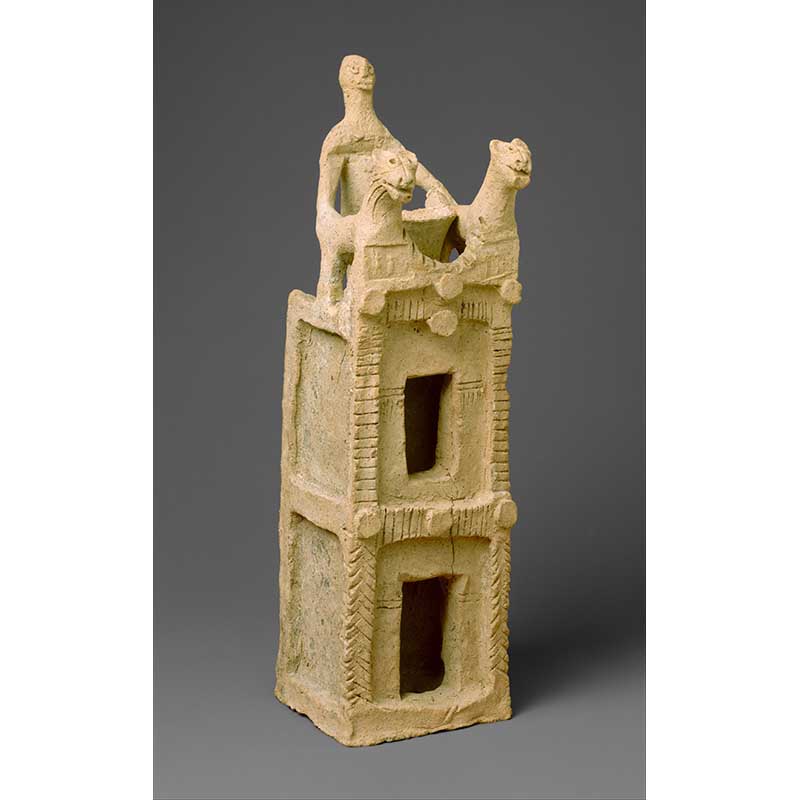
Image credit: Cult vessel in the form of a tower with cylinder seal impressions near the top, circa 1800s BC, Syria. The Metropolitan Museum of Art.

