The Delirious and True Tale of Mockingbird Pup and Little Flower
Brandon Hobson
The Beauty Age
Katherine Cart
Closing Down St. Stephen’s
Julia Alvarez
Purgatory
John Ashbery and Karin Roffman
Two Poems
Sandra Cisneros
Fireflies
Marie Myung-Ok Lee
A Pin for the Swallowing
Clare Beams
Remember Beauty
Jonathan Carroll
Dream Index
Greg Hrbek
Once Removed
Jennifer A. Kane
Every Joke I Remember My Mother
Jonathan Lethem
The Error
Martina Botti
Bird, Bath
Edward Carey
The Infant
Julia Elliott
From: Last on Earth
Shane McCrae
Five Midwest Stories
Peter Orner
Camp Wood
Rick Moody
This Is Not Dalí’s House
Michael Murphy
Strangle
Joyce Carol Oates
Seven Poems
Mark Irwin
Tonight, We Roll
Stephen Graham Jones
Two Poems
Nathaniel Mackey
Safekeeping
Lindsay Starck
The New Style and Other Poems
Angelo Mao
Pica
Adam D. Jameson
Three Poems
Colin Channer
Poems from the Lower River
Ruby Hansen Murray
Eight Poems
Rae Armantrout
The Gospel According to Phinehas
James Morrow
All things end, yet some rise to start anew. Whether through the grace of stubbornness, the tilt of the quixotic, the catch of a buoyant second breath, or the deeply ingrained habit of never giving up, some stand in the face of finales and write another act of the play. I can’t go on, I’ll go on is as familiar to readers of Beckett as it is a succinct way of describing the human will to carry on against the odds. Think of the jilted, the divorced, the widowed who give love another try. The dispossessed, the evicted, the expelled, the canned—re-emergent. The down-and-outer as up-and-comer. The clean addict, the cancer survivor, the paraplegic track and field champion. Think of the formerly incarcerated. The pest-plagued farmer who varies seasonal rotation—from corn to beans to spinach—to save the crops. Consider the exiled, exhausted knight of the road who finally finds a home in some Edenic woods.
This failure to fail, this hardwired impulse to regenerate is also a given in the natural world—miraculous, without fanfare. Floras perish and rise again, suns die and become supernovas, forest fires destroy but are followed by revitalization of the landscape. The starfish loses arms that through the mysterious process of regeneration appear again. The wood frog freezes solid as stone to survive cold winters then unfreezes in spring to resume its life, a humble feat that cryogenics has only dreamed of. Ostensibly extinct species of wildlife and plants and deep-sea fish are discovered even during this era of reduced numbers and decreasing populations. And migration, so essential to the diversity of all biospheres and cultures, is an act of reinvention, whether it’s made by people or by birds or even by virtue of birds that carry in their guts the seeds of plants that find new habitats in other fields.
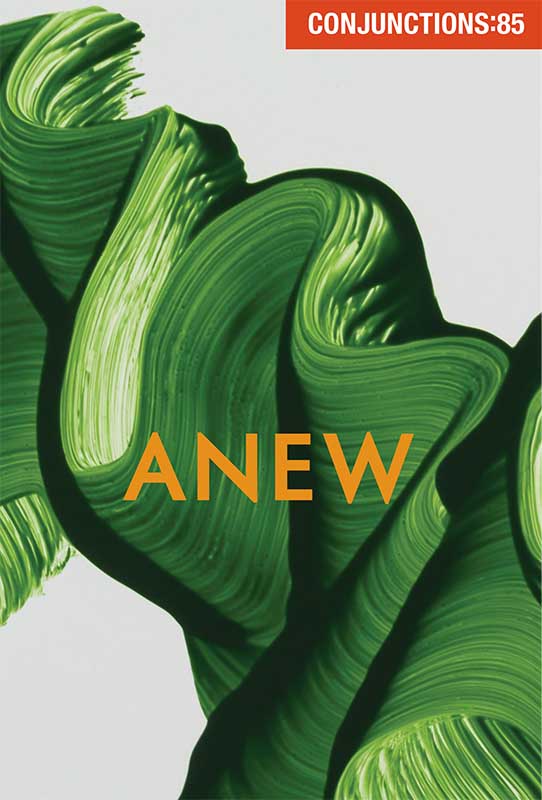
All this being said, starting anew emphatically does not guarantee a rosy outcome. Many if not most ventures fall short or fully fail. Back at the drawing board the lights may go out, the pencil break, the chair collapse, the will give out. Often, our paths come to inevitable ends from which there is no starting from scratch, no rising from ashes no matter how hard we fight the good fight. Conjunctions:85, Anew delves into the failure to relaunch as well as the reinvention of something thought forever lost. Just as the act of trying, trying again is the surest path to surviving—or failing with honor—Anew centers upon a theme that seems more pertinent than ever in a world of too many endings.