—With illustrations by the author
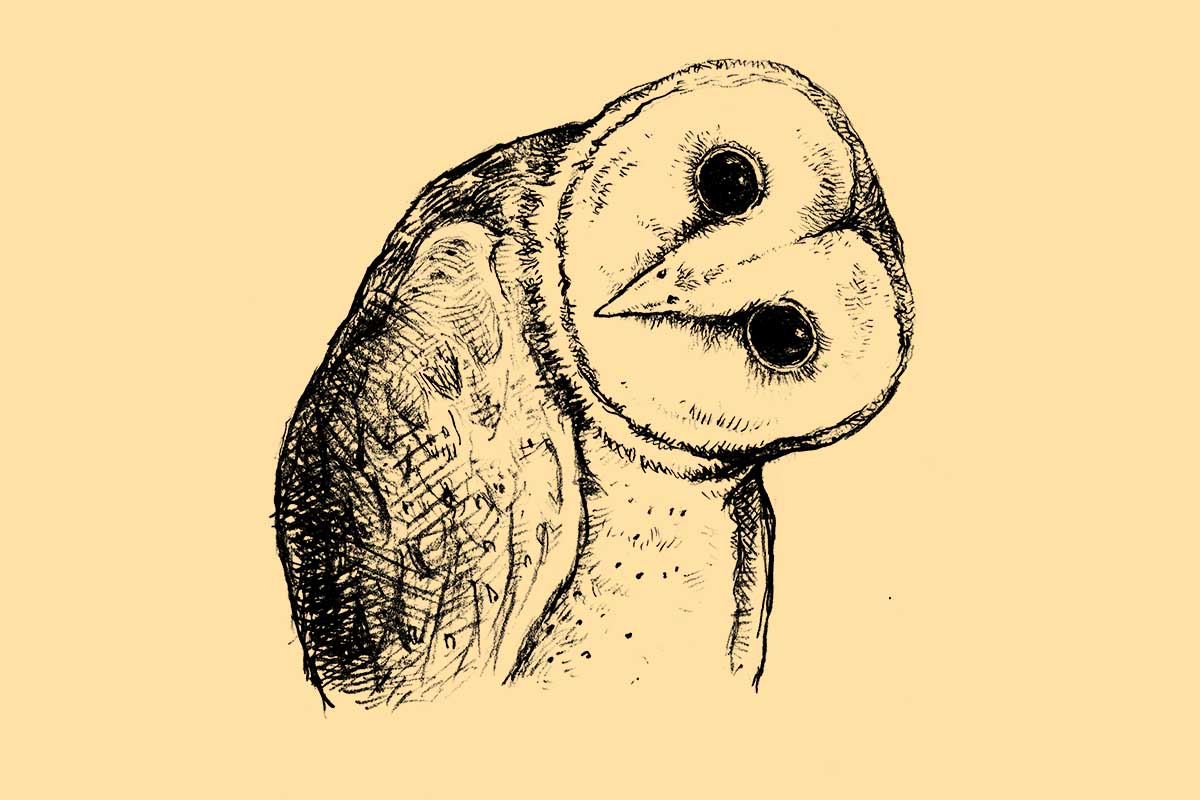
After over twenty years I came home. I left America, specifically Texas, and settled in Bath, Somerset, United Kingdom with my family. From Austin to Austen. When I first arrived in Texas, I had already been living in America in Iowa City and Cambridge and Saratoga Springs, but then we moved to Austin and I had no notion of it and could not read it. It was different from any place I had known before and to calm myself—and this is how I calm myself—I drew. In a depression, in a state of confusion, in a state of alarm, looking for inspiration, hoping for something, I always draw. No matter the result, the simple act of drawing, the small gesture of making a line on a page, each scratch a proof, evidence of an action, a marking of time, is a break, a relief, a restart. I try to think in pencil and not in words, and it has always worked—
not the drawings necessarily, so many drawings get crossed out, rubbed away, torn from the pad—but just the gesture, the simple act, and afterward I feel I can go on.
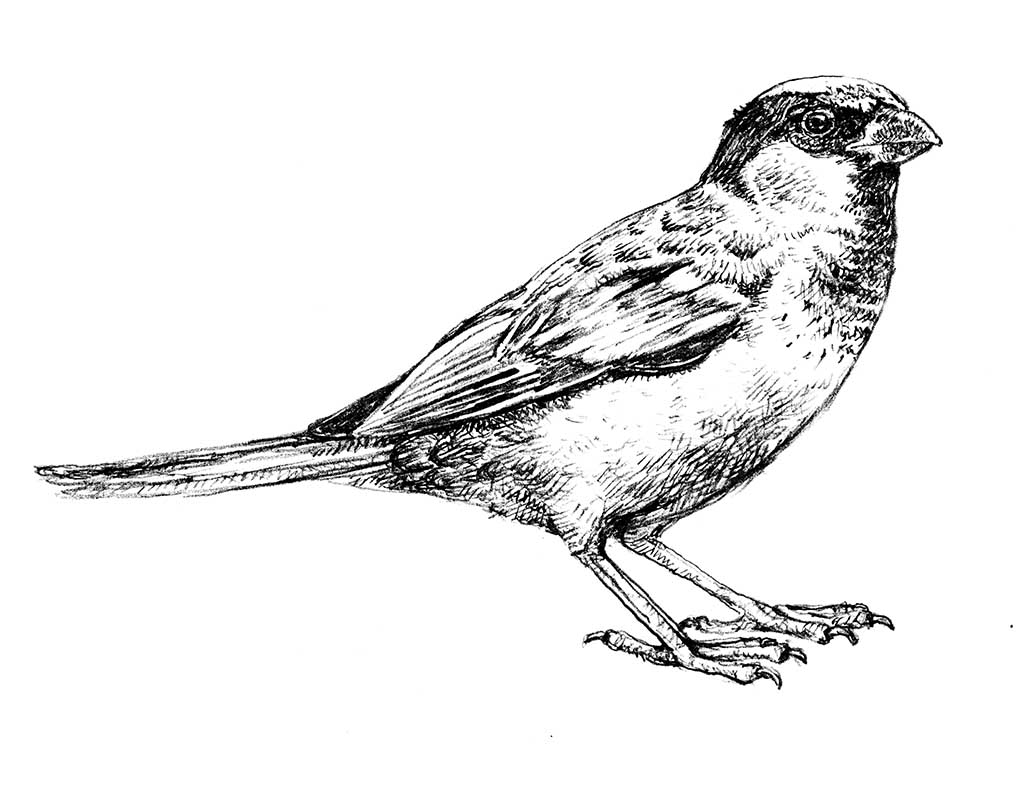
To learn Texas, at first I had to choose something constant, something always around that I had not seen anywhere else. After the briefest of searches, there it was. A scarecrow of a bird, which makes a noise like rusted machinery on the point of giving up, that thing, that shrieking umbrella ruined by strong wind, there that, that thing, that creature. What is that with the furious yellow eyes, what is that twisted thing made up of old daguerreotypes of dead, spiteful people who hang around in bird form waiting for their anger to run out? What do you call them? I asked and the answer was: a grackle. The grackle was in the background of my life for the next decade and a half, and sometimes with a screech it insinuated itself in the foreground by the theft of food eaten outdoors or simply by twisting its neck and making noise so close to me it was impossible to ignore. Beggar, thief, poor relation, burnt offering, feathered coat hanger, as uncomforting as the Texas summer sun, there it was again, tearing the landscape with its uncanny alarm.
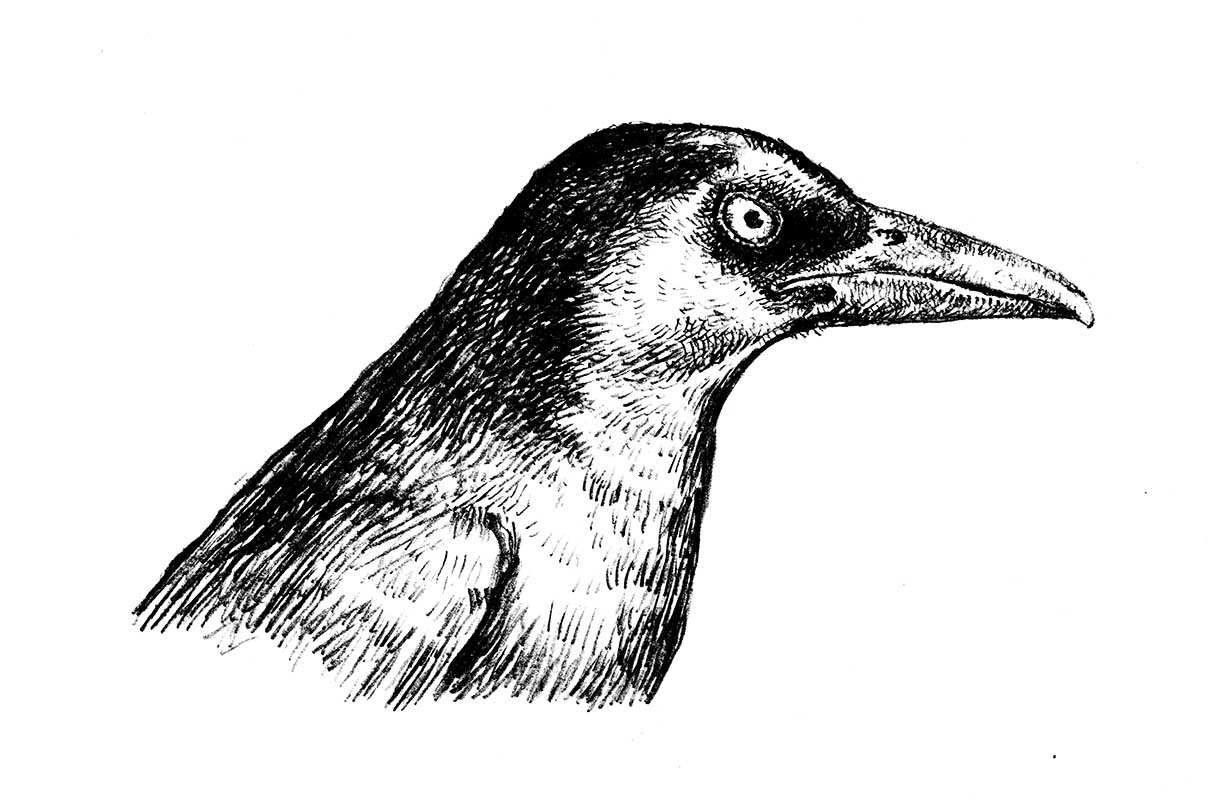
So the grackle was my starting point to comprehend my new home. I drew this common thing, this Beckett character that populated my new streets. Over the years, I would draw perhaps a hundred or more grackles before leaving America. I would never tire of drawing a grackle. It is one of the things I miss most about Texas.
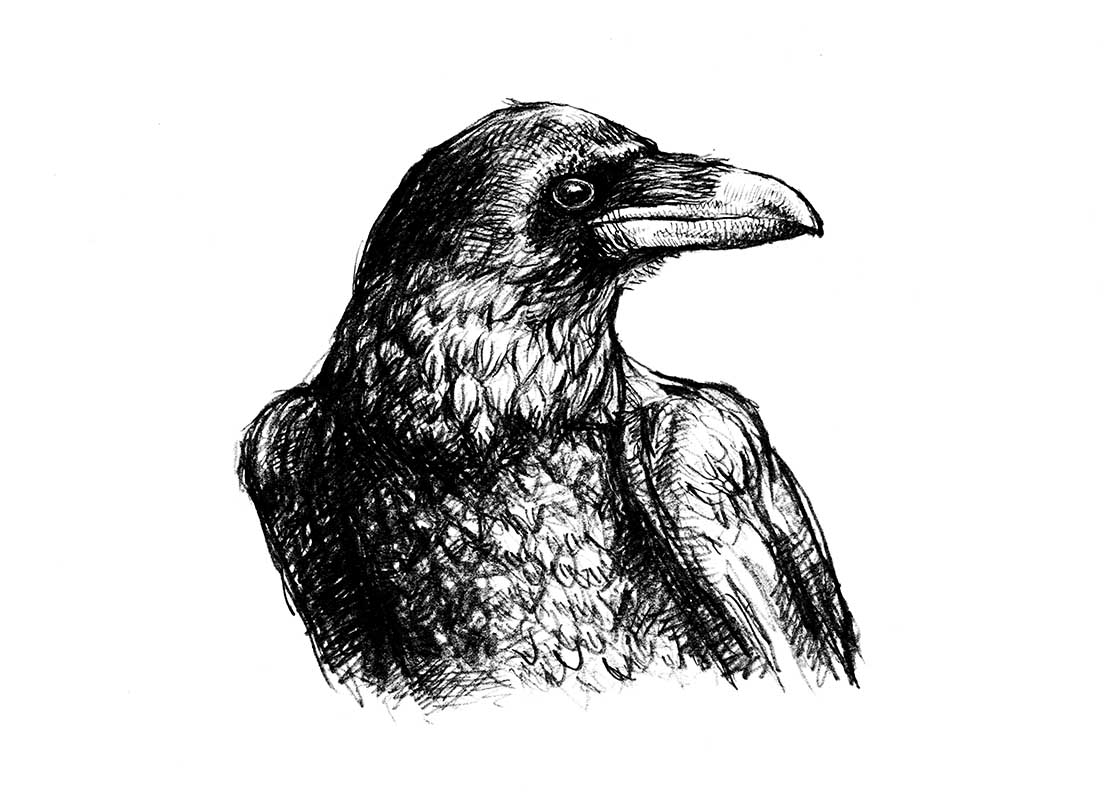
The grackle is also my leaving point. I’ve drawn and painted it so often, written essays about it even and short stories (I even based a commencement speech for the UT English Department on a person I proposed was the inventor of the grackle) and now that I am back home I must move myself away from grackles. My leaving was the grackle, my return the crow. The carrion crow is a wiser, more mysterious bird, more sociable, more intelligent, more ominous perhaps, and it is my first drawing back on English soil. I had forgotten how deep these birds are, how beautiful, how folkloric; you see them in the paintings of Brueghel, their black forms punctuating the sky. The crow: it knows something we don’t. Its various noises giving warning of predators, the female’s popping sound, the machine gun fire coming out of its mouth, and the great noise of hundreds of them in assembly, wheeling in the sky, calling to one another: that is the sound of my childhood, of my childhood self standing in the countryside. I listen to the crow and I am home again. The crow is my point of arrival, hopping, cawing, busy, thinking. My pencil is out, there are lines on the page.
And just by drawing I feel that this is better, I really am home again, am physically here. But I’m waiting for my entire self to catch up with me and the drawing is the way to it, for the drawing is a declaration. Crow, I’ve come home.
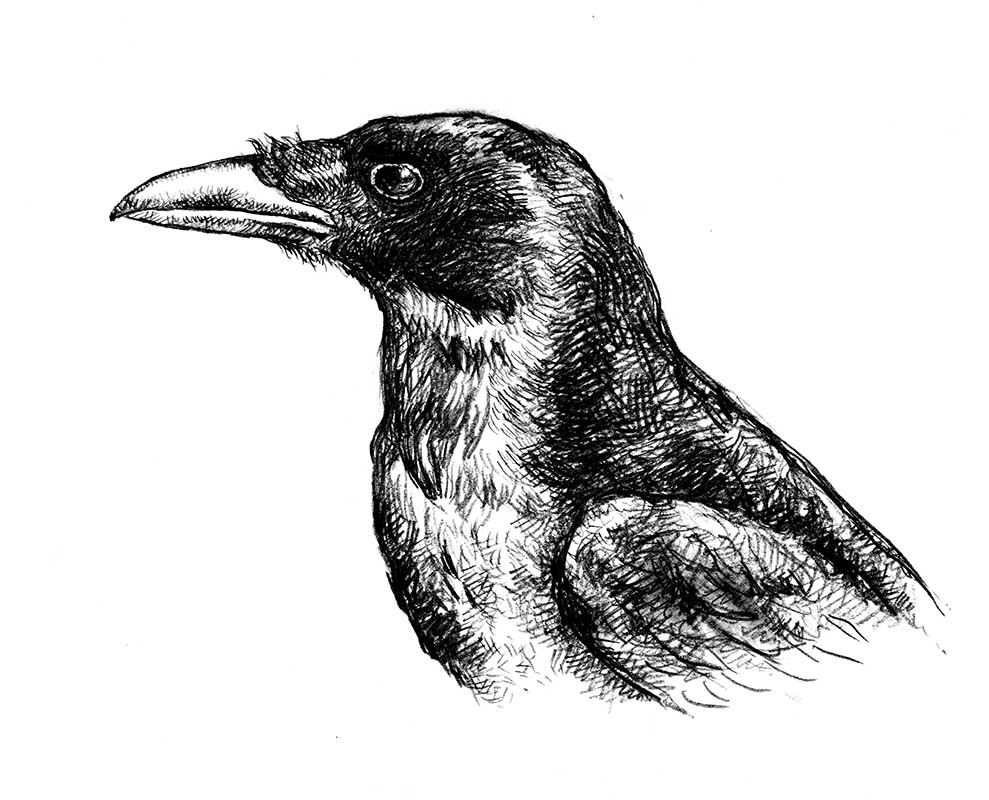
Yes, the crow is a start, but only the start. I must gather more birds back to me. Next must come the magpies, these birds always so smartly dressed in their sharply contrasting black and white and also the beautiful purplish blue on their wings and tail feathers. I was always rather terrified of magpies as a child. They have a reputation for being extraordinary thieves, but they’re not apparently. Also the children’s nursery rhyme “One for sorrow, two for joy . . .” would send me into a brief terror if I saw one alone. They don’t terrify me now; I am glad to see them. Even if they do have strong opinions and appear to be saying: I don’t need you.
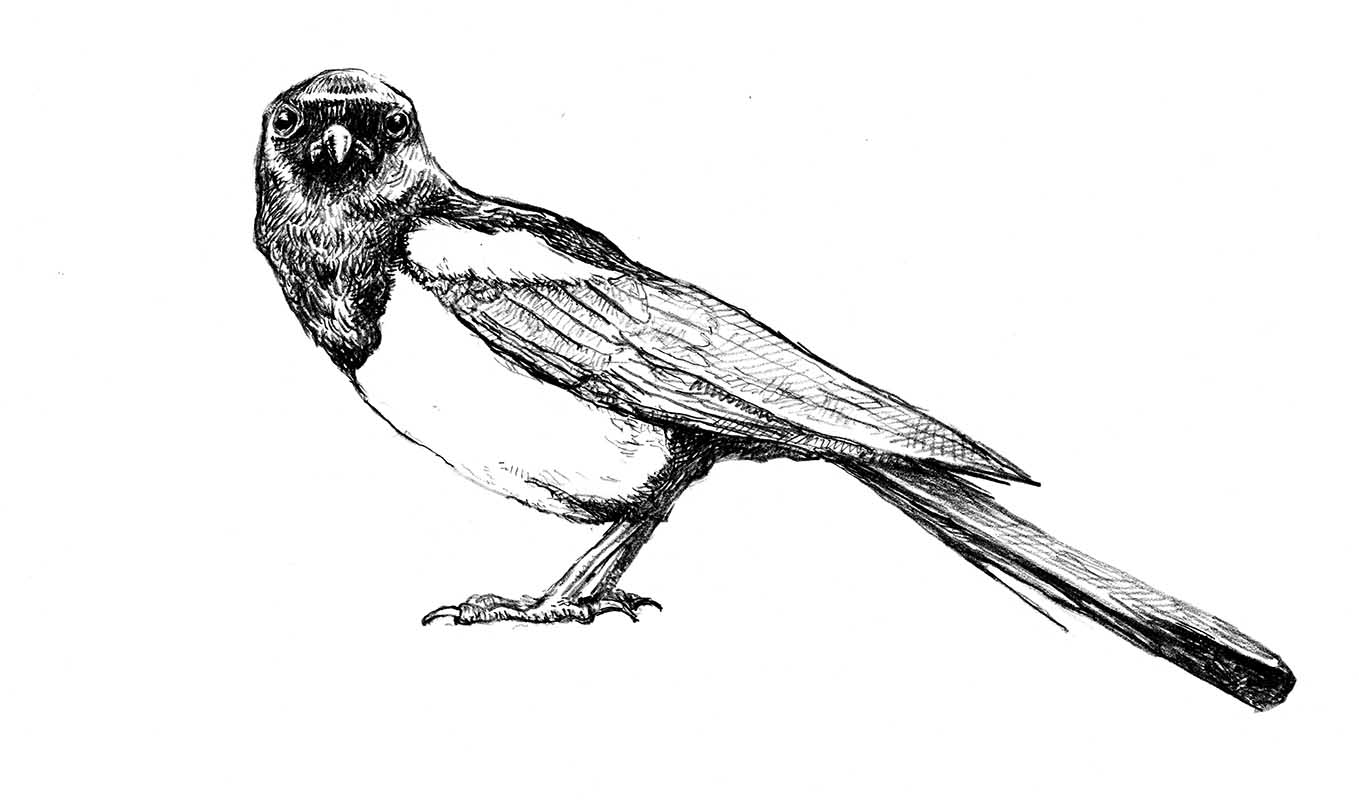
Like the crow—and unlike the grackle—magpies are members of the family Corvidae along with jays and rooks and ravens. And so the raven comes next onto the paper. These birds I see less often in the countryside but are always guaranteed to be present at the Tower of London, for, so goes the legend, if they ever leave the tower, the castle would come crumbling down and with it the whole kingdom.
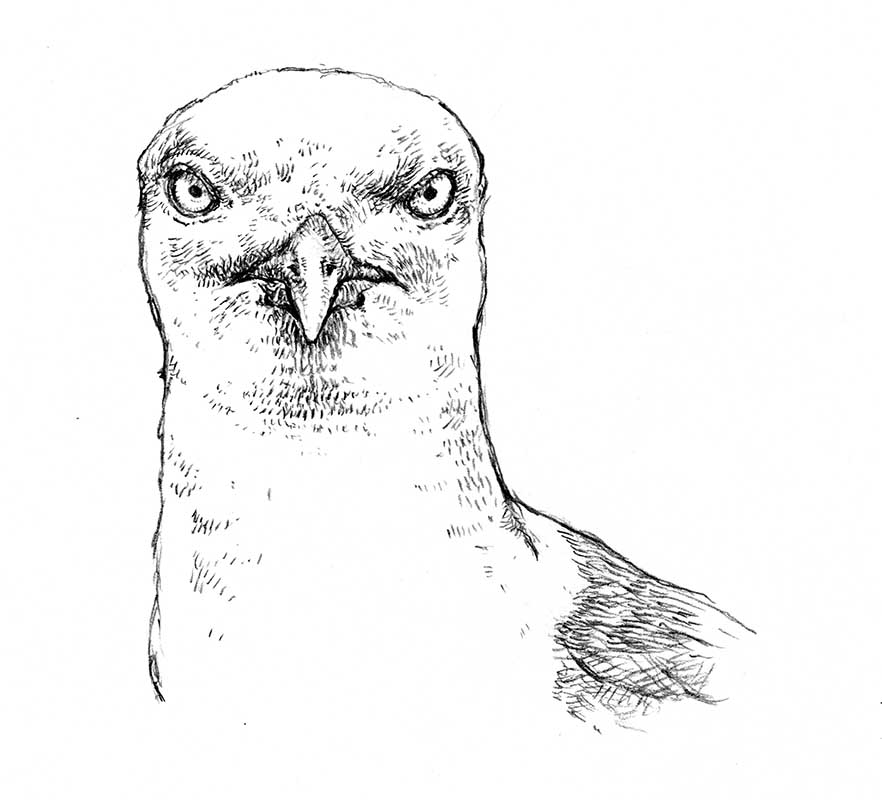
I set out on my walks, descending the district called Bear Flat, into the city of Bath, with its Georgian limestone buildings, and there, pottering about, as confidant as the shoppers, more so, are the seagulls. These herring gulls are large and bossy and posted here and there are signs in English, in French, begging people not to feed the seagulls merci de ne pas nourrir les mouettes. How they shriek in annoyance at this, like the black-headed gull Kehaar in Richard Adams’s novel Watership Down. That character was based on a displaced Norwegian soldier from World War II and the sound “Kehaar,” which the soldier would often make, was his imitation of the noise the waves made back in his homeland. This was a book we loved almost more than any other, but it felt so personal, and so it was best not to talk about it, to hold it to yourself, and then, in 1978, the film came out, the beautiful, brutal animated film, which we saw after we’d read the book, with all its sacred voices—John Hurt, Ralph Richardson, Denholm Elliott, Richard Briers, Harry Andrews, Nigel Hawthorne—almost as precious as bird’s song those voices were, though so much more mortal. And giving the seagull voice was the American Zero Mostel. It was his last ever performance.
Before, when I still lived in Texas, I returned to England for short periods where I would drink up the landscape knowing I wouldn’t be here for long. I watched with longing the annual arrival of the house martins in my mother’s garage, felt the joy of their arrival and the pain of the loss when they must fly back again. Now, as I walk around the Somerset countryside, it is August and the swifts have already left for Africa, but the swallows are here yet, speeding over the River Avon, skimming their wings upon the water.
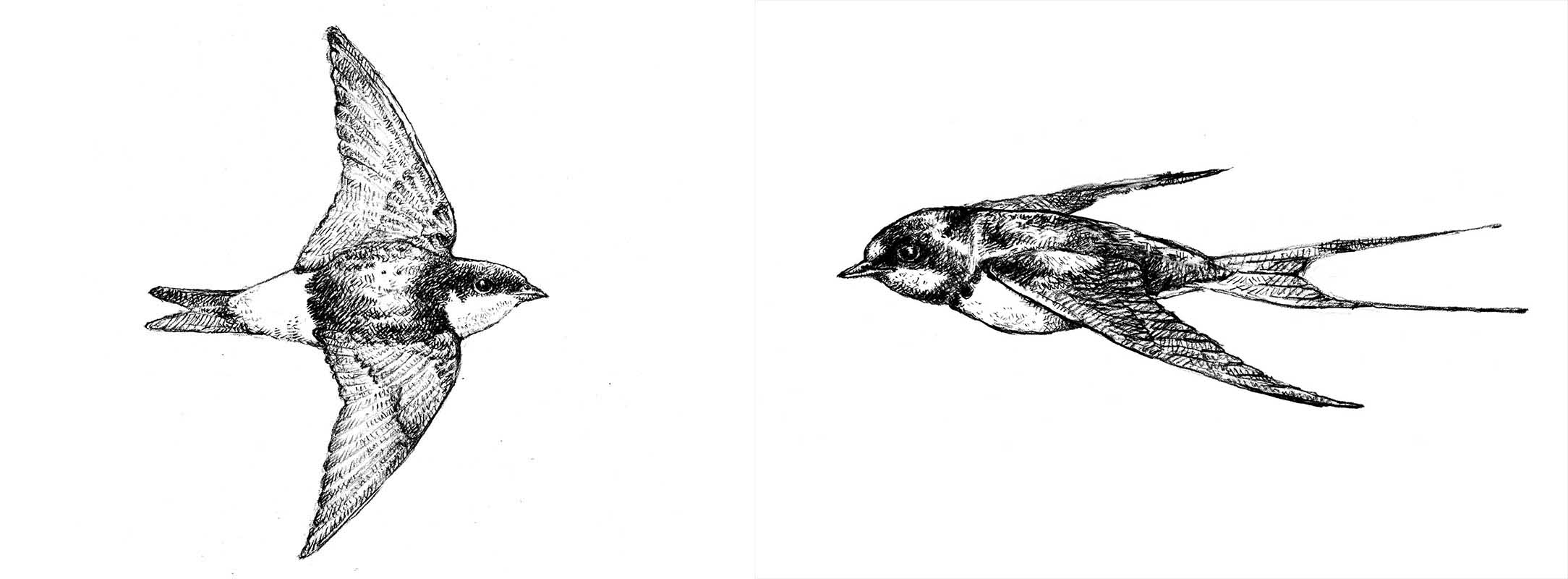
And with the swallows, I’m back again in the literature of my childhood, in the Lake District with Arthur Ransome. The sight of the swifts and swallows always marked the beginning of summer, but also we, my siblings and I, would compete with each other on who could hear the first cuckoo in spring. The oldest song in the English language sung in Middle English is “Sumer is icumen in / Lhude sing cuccu.” The summer is coming to an end when I walk in England again and soon it’s autumn and the first smell of winter is here and with it the bone coldness.
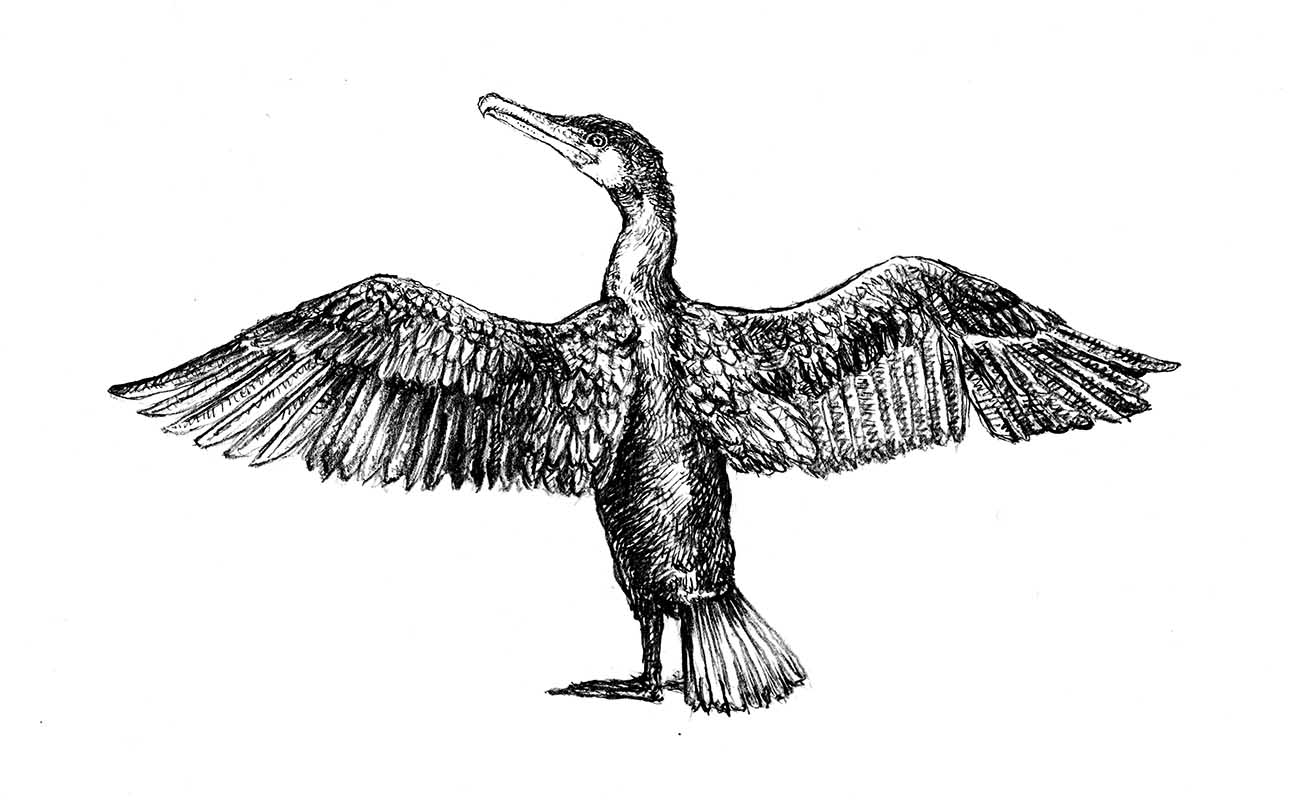
The cygnets on a late October day still have the last hint of gray upon them, still following their parents on the water. And there is a cormorant on a rock on the Avon, drying its wings. That bird was part of my childhood too, in the form of a character called Graculus in Noggin the Nog, a stop-motion animation made in a garden shed by two of the greatest geniuses in all children’s programs. I don’t know how to explain the brilliance of the work of Oliver Postgate and Peter Firmin except to say that their principal ingredient could be described as melancholy, a great sadness for lost things.
Read the full text in Conjunctions:85, Anew.

