The abuela wants desayuno chino. The mother knows the children will not like the food, but it is her ex-mother-in-law’s seventieth birthday, and so she gets to choose. The father is not with them, though the abuela is his mother. Too much work, expensive tickets, conflicting schedules. Amid so many explanations for his absence, the real reason remains unspoken.
Their visit has fallen during the dry season when breezes cut across the city, though it is hotter than years past. During every trip before, after the abuela welcomed them at the airport and they drove the coastal highway, through traffic, past tall buildings and familiar storefronts, under the pedestrian walkway of Vía España and into the El Cangrejo neighborhood, after they wheeled their bags through the abuela’s ground-floor apartment to the back bedroom, where the frosted glass-slatted windows allow the city’s sounds into the room—a car door shutting, parakeets squawking, a child crying, motors thrumming—along with the roasted, malted smell from the nearby coffee and beer factories, the mother would lie down on the father’s childhood bed and breathe it all in: the sweet humid air, the near-equatorial sunlight, the anticipation of a week in Panama after a year or more of absence. This time, the mother and the children wheeled their suitcases to the back bedroom, but she did not lie down. Is it right to lie on the childhood bed of the man who is no longer your husband? Is it right for her to be here at all?
They have eaten at this restaurant before. When the boy was a baby, he put his palm on a shiny metal teapot filled with green tea. Baffled by the source of his pain, he let his hand rest there, and everyone wondered why he was wailing until they saw his hand and pulled it away. The boy was sitting in the abuela’s lap when it happened, and the mother was furious that the hot teapot had ever been placed in front of the child and that no one had noticed, not even the abuela.
Now the boy is in second grade and the girl is in fifth. When you were little, the mother tells the boy, you burned your hand here. We had to take you to the emergency clinic. The doctor saw them right away and wrapped the boy’s pulsing pink palm in a gauze bandage, which the mother later held above the waterline while they bathed in the Caribbean and she cried because he could not splash in the sea. Remembering that day now, the mother thinks not just of the palm but of other families that they had rushed past in the waiting room—the boy so upset, the mother so distraught, her family’s skin so much lighter than the skin of the other patients—and she wonders which is true and which is worse: the other families letting them skip ahead or her family taking another’s place.
The rattling cart arrives at the table, stacked high with silver steamers. Siu mai, har gao, baozi, the abuela says. The mother wonders how the abuela’s pronunciation sounds to the server who places the metal containers on the table with tongs, one by one. She is both relieved and annoyed not to be the one ordering.
What is that? the girl asks and points to fried chicken feet smothered in golden brown sauce.
Pata de pollo, the abuela says.
Chickens’ feet, the mother says for the boy’s benefit.
To her surprise, the boy and the girl each take one. The boy pokes at the saucy foot and leaves it on his plate. The girl puts a claw in her mouth and sucks, then removes it and pries the flesh from the bones, leaving small phalanges on her plate, like she has just dissected an owl pellet.
The abuela’s birthday dinner is at the top of a thirty-floor building, and the ride in the elevator is quick, like they have been sucked up a straw. This is the home of the father’s aunt and uncle, his cousin, and the cousin’s children. Everyone hugs and kisses the children and the mother at the door. It is just like two years ago, except the father is not with them and the mother is no longer his wife. She wonders if the family is also thinking about this as they embrace.
They have wine, cheese, and bread in a sitting room that overlooks the coast while the boy and the girl bounce around the apartment. The children are energized by the family’s wonder at their heights and their own wonder at the height of the building. The boy circles quickly through the penthouse rooms, past Italian ceramics on end tables and large vases on stands, and the mother imagines the way these will shatter. She calls the boy to her and warns him like it’s a museum, but he is undaunted and continues his speed walking, albeit a little more carefully.
At the dinner table, the cousin shows the mother TikTok videos promoting the family’s beauty supply company. My parents hate them, the cousin says in English that curls hard around the r. They don’t understand that we need social media. She plays a short video of herself, beautiful, advising the viewer to dye one’s hair for different occasions. Birthday coming up? Píntate el pelo. Got a new job? Píntate el pelo. Recently divorced? thinks the mother and touches the gray at her temples. The cousin’s face fills the screen. ¡Y serás una perra empoderada!
¡Perra empoderada! the great-uncle booms from the head of the table. He turns to the mother. An empowered bitch. What do you think of this?
Daaaad, the cousin says in English. Being a bitch is a good thing. She looks at the mother for backup.
In English, the mother says like she has thought about this before, a bad bitch is good. But a bitch is mean.
In Spanish, the great-uncle says, a perra has sexual connotations.
Perra empoderrraaada. The cousin rolls her r’s hard at her father, opens her a’s wide. She turns back to the mother. We have more than a thousand likes.
The great-aunt pours more red wine into the mother’s empty glass, then continues filling glasses around the table.
The great-uncle asks about the father. How is his business going?
Good, I think, the mother says, though in truth she does not know. It is not her job to know anymore.
¿Crees, o sabes? The great-uncle calls her out.
She pauses. I don’t really know, she says.
And is he a good father? the great-uncle asks.
Oh, yes, the mother says instinctively. She looks at the abuela, whose expression is unreadable as she gets up and walks to the sideboard with her empty plate. The kids spend a lot of time at his place.
Just like the perras empoderadas, the great-uncle says and laughs, as does everyone else at the table. Even the mother laughs, though she is not sure why. What she knows is it is not her job to know anymore.
The following morning, the abuela, the mother, the boy, and the girl prepare to depart for their trip to an Emberá community. Soon, everyone is ready to go except for the boy, who has lost his shoe.
Tell abuela you can’t find it. No puedo encontrar mi zapato, the mother instructs him.
The boy does not want to say the words. He and the girl spoke mostly Spanish at home until they were three and started preschool. Now the boy is eight and refuses to speak Spanish.
The mother says it louder. No puedo encontrar mi zapato. That’s what you say.
I don’t know what that means, the boy says.
No. Puedo. Encontrar. Mi. Zapato. Tell her! Tell her! The mother hears herself and knows that this does nothing to help the boy want to speak Spanish, that she has gone too far, but she is sad and cannot stop herself. This is the room where she cried. That is the bench. There is the street corner. Her self of two years ago is still pacing the city’s sidewalks in the dark, pushing away the children’s father, who is pushing away her breaking heart. She shouts no! anytime he comes close and tries to calm her, anytime he tries to herd her back to the apartment and bring their fight inside.
I’m going to get arrested if you keep that up, he says. She knows what it sounds like and stops shouting.
You know whether it’s English or Spanish from how the no sounds, says the boy who will not speak Spanish. In English, it’s no. His no is elongated. It is a child sprawling on a couch. In Spanish, it’s ¡no! The child suddenly sits upright on the same couch.
The abuela drives the entire way to the rainforest river port, taking the cross-isthmus highway that runs parallel to the Panama Canal and then ascending into the hills. They pass turkey vultures roosting in an impromptu dump that doesn’t so much end as become a gradient of trash, the plastic bags caught in the barbed-wire fence spacing farther and farther apart until the usual pace of drive-by litter resumes.
At the Río Chagres, they board a flat-bottomed wooden canoe with an outboard motor. Their guide is Emberá and dressed in a white polo and khaki pants. He wants to take them to a different community than the one the abuela wants to see. She argues with him and then relents. It better be just as good, she says in Spanish, and he assures her that it will be.
The boy and the girl are slick with sunscreen and insect repellent. The boy is very fair and his skin reddens in the sun like the mother, while the girl tans easily like the father. Even though, the mother says. You still need sunscreen. She wonders whether it is too grim to talk of future cancers but does anyway. She has never been one for the tales told to children, for Santa and the tooth fairy. An artist who doesn’t like to make things up? a friend once chided her. Who doesn’t like to lie to her children, the mother said.
They reach the first community, and the abuela does not like it. No me gusta para nada, she says, flicking her hand toward the wooden stilt houses and the people coming out to greet them. Está fea, she says. The guide nods and continues upriver. The mother turns around and sees a family standing on the shore. They recede from each other as the boat speeds away.
Are we there yet? the boy whines. The mother doesn’t know whether to scold or to laugh at this question always being the same, regardless of the means of transportation.
We’re here to enjoy nature, she says. And to learn about the people who live along the river. She wants the boy and the girl to understand that despite assessing themselves as average, they have so much compared to so many, to understand that people live many different ways. The abuela had suggested the outing, though the mother is not sure if it was for this purpose, or if the outing is even the way to create this understanding, or how much understanding is even possible when one is in a position to desire it.
The river narrows and green walls of vegetation form on either side. There are rocky partings in the understory, waterfalls here, inlets there, and midstory clearings crosshatched by vines.
There may be monkeys, the mother says.
I don’t like monkeys, the boy says.
He’s scared of monkeys, the girl says with a smile, and they all think of the time two trips ago when they visited the animal rescue center in the western highlands. They remember the small furry hands that reached through the chain-link cage to grab the boy’s head and bite into it like a melon, the way the boy’s hands flapped at his sides, as he and the monkey shrieked. The father was with them then. Then they were still four, instead of three plus one. The mother thinks of the many ways there have always been to divide their family: anatomy, skin tone, last name, first language, the sound of fireworks—a celebration or an invasion. It is impossible math.
The canoe scratches against the bottom of the river, which is just inches from the surface. The water looks impossibly shallow, impassably shallow, yet somehow the guide finds a way. He turns the outboard motor toward a channel, and they glide through until they hit the stones again and release, again and release, again, and this time they are stuck. The motor struggles against the riverbed as the guide cranks the tiller, and the air fills with highway sounds and the smell of diesel.
What if we get stuck here forever? the girl asks.
Dun, dun, duuun! the abuela says gleefully, and the girl looks to the mother for reassurance. River stones churn as the guide continues flooding the motor, and the mother understands that this is why he did not want to come to the upriver community. He gets out of the canoe and pushes the back end. ¿Bajamos todos? the mother asks, and the abuela shakes her head.
The guide leans over and places his weight into pushing, arms outstretched. The canoe drags along the bottom until there is another release and they are free of the stones. The guide steps back into the canoe. His sneakers are waterlogged, his polo damp with sweat.
I wanted to get out, the boy says as the canoe slices through the water, the motor whirring smoothly behind them again.
The Emberá man who gives them a tour of the community stands near a wilted garden and grasps different plants in his hand one at a time. His skin is painted with faded blue-black lines in angled geometric shapes, and he wears a short wrap around his lower half. As he says the plants’ names and medicinal uses, the boy runs up and down the path, past other groups of tourists. The mother calls the boy back, but the man says it’s fine. Déjelo correr. She wonders what he wears when they all leave.
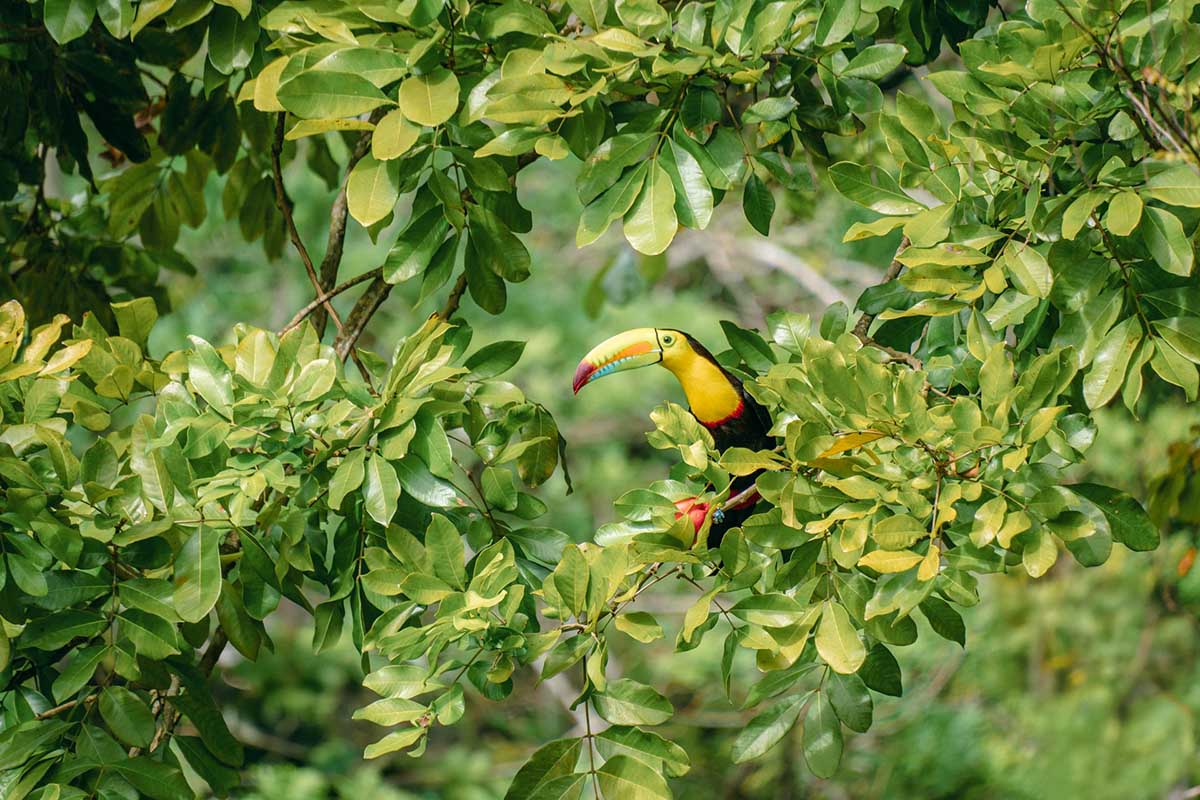
The girl looks for a domesticated toucan that the man says should be under one of the stilt houses. The children in the community saved the bird after a harpy eagle caught it and accidentally dropped it into the river. Its wings were irreparably damaged. Usually we domesticate toucans when they are babies, but this one was already an adult, the man explains in Spanish. The mother listens hard to everything he says because the children do not.
He is the third person that the abuela has introduced her to that day. Ella es la mamá de mis nietos, the abuela said to the guide as they climbed into the canoe at the river port. Ella es mi nuera, the abuela said to the young man who greeted them as they climbed the wood-framed earthen stairs up to the community. Ella es la esposa de mi hijo, the abuela says to this man.
The mother smiles, as if it is something so light as to be funny. Ex-esposa, the mother corrects her, having kept quiet at nuera, but not this.
No me importa, the abuela says, again flicking her hand, and the mother says nothing. She wonders what hopes might be caught up in this not-mattering.
After the tour, dancers perform for the tourists and provide them with fried river fish and steamed plantains wrapped in leaves. The boy and the girl do not sit for long and instead go scan the jewelry laid out on tables. Each picks out a small beadwork hummingbird to take home. The young man who had greeted them when they arrived stands near the tables talking in their language to one of the women. A child climbs up him for a piggyback ride without asking, just like the boy does to the mother, and the young man gently helps the child back to the ground. He is more patient than the mother. She is full of questions, and so she approaches him, and the woman he is speaking with steps to the far end of the table. The mother says hello and thanks him for having them there. She asks if they like the tourists’ visits and whether the tourists are respectful.
He smiles. It’s been so long now, thirty years, he says in Spanish. He is clearly younger than thirty. We are used to it. It’s as if you all are part of us now. We are like family.
She studies his face and considers how the relationship that he describes is at best co-constructed, and more realistically, imposed. She wants to know what he really thinks, but is there any room for him to tell her? What would you be doing if we were not here? she wants to ask. What would it be like if we were not family?
On the drive home the abuela takes a different route, and a strange factory-like building with gray and beige towers rises into view, like a lost city from a dirty future. ¿Qué es eso? the mother asks. The abuela doesn’t know. Es como una ciudad perdida de un futuro sucio, the mother says. She does not usually talk with the abuela this way and half expects her to laugh. Instead the abuela tilts her head to the side and says, Verdad, ¿no?
Look, the mother says to the boy and the girl. Look at that.
They all watch the structure grow and turn. It shows them its various facades as the road snakes around it but is no more coherent the closer they come, and eventually it is lost in the distance.
On the weekend, they head to the island just off the Caribbean coast where the abuela has a small house in town. The mother has come here many times before. There is the beach where a British biologist friend said the father fancied the mother. There is the tree that the mother drew in ink across the span of two pages in a sketchbook wider than tall. There is the reef where the mother met eyes with an eel and chased small blue- and yellow-streaked fish, holding her breath as she descended. There are the shallows where the mother and the father lay bellies to seagrass and pressed their cheeks and lips together for the camera. There is the beach where the mother held the girl’s hand as she toddled into the water in a bathing suit the same bright colors as the island’s little houses, shrieking with happiness. There is the tree that the mother walked to by herself, picking up trash along the way. There is the reef where the mother searched for eels and streaks of color yet found only faded coral dusted with sand. There are the shallows alongside the path where the mother told the father, It’s like I’m watching you fall in love with someone else. There is the beach where the mother and the children now swim and the boy pleads to go out to the buoy line even though he can only doggy paddle. There is the tree that the children climb so they can jump from its branches into the water. There is the reef that the mother no longer visits because she knows that so much of it has died. There are the shallows where the mother and the girl find sea urchins under fallen leaves and seagrass blades that barely cover their bodies, like young children playing hide-and-seek, convinced that they are hidden.
The mother takes all of this in and thinks of her cells turning over every seven to ten years. She holds out her arms in front of her, twisting them this way and that. It has been twenty-two years since she first came here.
The abuela has brought her two cats, down from three. Street cats who have learned to tolerate the apartment in the city, to love the abuela, to come back after running free on the island. The mother keeps calling the one named Venus by the dead cat’s name. The boy and the girl correct her. Venus in Spanish lands awkwardly on their ears. She and the children work hard to say it correctly, to forget the spelling so that it becomes another word entirely unrelated to how it’s written: baynoose. They remember their joke from two years ago: Venus is the answer to everything. Who knocked over the flowers? Venus. Who’s under the bed? Venus. Who scratched the boy? Venus. As they set the patio table, they tell each other the joke in English and laugh and laugh. ¿Qué? says the abuela through the open kitchen window. Venus es la respuesta a todo, the mother explains, but it makes no sense in Spanish either. The abuela laughs and shakes her head, and the children continue giggling.
Over breakfast, the girl tries to work out the relationships of everyone she met on the abuela’s birthday. Papá’s aunt is who to us? And Papá’s cousin? And the cousin’s children?
The mother’s head swims with her vague understanding of second cousins and cousins once and twice removed. Great aunt, for Papá’s aunt. First cousin once removed, for his cousin. Her children are second cousins to you, she says to the girl, though she isn’t certain.
And in Spanish? the girl asks. The mother does not know the words in Spanish for the children’s relationship to the father’s extended family, or for hers either. If anything, the mother is more removed than anyone else—no shared blood, her link by law dissolved.
Who is your sister to the children? the mother asks the abuela in Spanish.
Su tía, the abuela says.
And her daughter?
Tía también, the abuela says. Y sus hijos son sus primos.
Aunt. Aunt. Cousins. The mother marvels at how simple it all is. Nobody is removed, nobody is second. If those words exist, they will not be spoken here.
Now they wait out a rainstorm and return to the beach to look for fish after lunch. Twenty-two years ago the schools used to flit along the shoreline and circle a small outcropping of coral before heading out to the reef where the waves break white and foamy. The mother knows she has seen fish here since then but does not remember when was the last time.
Today driftwood is scattered across the sand and dark masses float beneath the surface of the water. The girl wades in and picks up big green globs. She throws them at the boy while he watches from the beach, the mask and snorkel at his side. The mother wades in too. She runs her hands through the water, and the algae catches on her fingers. It is soft and woolly, like loose felt soaked through. She looks to the far shore, beyond the boats running the channel and the town on the other side, as if she might be able to see the source of the pollution that causes these algal blooms that kill the fish—but the mainland is a paradise, its forested hills lit up silver in the afternoon sunlight.
Against this backdrop, the abuela watches them from a beach chair, a beer in her hand, a sunhat shading her eyes, her shoulders bare and speckled. She is smiling while the girl gathers the algae and the boy sits in the sand, and the word ex-mother-in-law fails the mother, broken open by her surging heart.
Don’t you want to clean the water? the girl calls to the boy, who stands while the two women look on. Don’t you want to save the world?

